
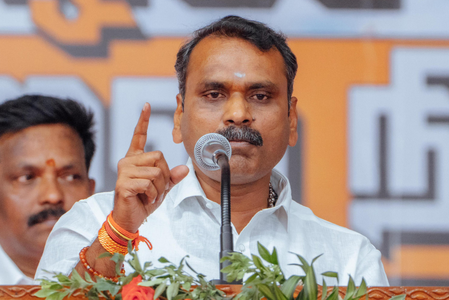
New Delhi, July 27 (IANS) Minister of State (MoS) for Parliamentary Affairs L. Murugan told the Rajya Sabha on Monday that 33 out of the 37 State/UT Legislatures have signed Memoranda of Understanding (MoUs) for the implementation of the National e-Vidhan Application (NeVA).
Replying to a question, Murugan said, “Out of these, 21 Legislative Houses have been transformed into digital Legislatures under the NeVA project.”
The Minister of State said that the digitalisation of the two Houses of Parliament is outside the scope of the NeVA project.
He said NeVA has improved the efficiency of legislative functioning by enabling electronic processing of House business.
It has reduced dependence on paper-based procedures, facilitated faster processing and dissemination of legislative business, improved accessibility of legislative information, and resulted in cost savings in printing, handling and storage of documents, said MoS.
NITI Aayog has undertaken a mid-term evaluation of the NeVA project. The evaluation report, inter alia, observed that NeVA has reduced paper usage and improved legislative workflows.
Enhanced coordination among Legislatures and Government Departments has facilitated quicker processing of legislative business, and the NeVA public portal provides real-time access to legislative documents.
The report also noted that capacity-building initiatives, including establishment of NeVA Seva Kendras, have supported adoption of the platform by providing technical assistance and training to stakeholders.
The NeVA application is upgraded from time to time based on user feedback and operational requirements, he said.
Murugan said that the NeVA application has been migrated to the secure NIC MeghRaj 2.0 cloud infrastructure to enhance cybersecurity.
Integration with BHASHINI has enabled text-to-text translation of public portal content, improving linguistic accessibility.
The application has been designed as a device-agnostic platform to ensure interoperability across devices. Role-based dashboards and workflow-based electronic processing of legislative documents ensure coordination between different user roles such as Members, Secretariat of Legislatures, and Government Departments, he said
–IANS
rch/dan