
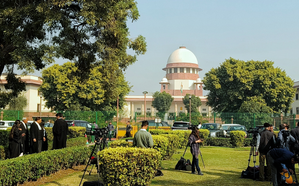
New Delhi, Feb 11 (IANS) The Supreme Court on Wednesday asked the Calcutta High Court to independently examine whether the invocation of provisions of the Unlawful Activities (Prevention) Act (UAPA) by the National Investigation Agency (NIA) was justified in connection with the recent violence at Beldanga in West Bengal’s Murshidabad district.
A Bench of Chief Justice of India (CJI) Surya Kant and Justice Joymalya Bagchi was hearing a petition filed by the West Bengal government challenging the Calcutta High Court order, which had granted liberty to the Union government to consider an NIA probe into the Beldanga violence, along with the subsequent notification by the Union Ministry of Home Affairs entrusting the probe to the anti-terror agency.
Dismissing the state government’s plea, the apex court directed the NIA to submit its status report — whether post-investigation or during the course of investigation — before the Calcutta High Court in a sealed cover, indicating whether a prima facie case under the UAPA was made out on the basis of material gathered.
“Since there are only passing observations in the impugned order of the High Court, without any definite opinion in relation to the attraction of the UAPA, we request the High Court to consider the status report of the NIA independently and issue consequential directions,” the CJI Kant-led Bench ordered.
The apex court clarified that it has not expressed any opinion on the merits of the matter and directed that the West Bengal government’s plea be heard by a Division Bench headed by the Chief Justice of the Calcutta High Court, before whom a related petition is already pending.
During the hearing, the CJI Kant-led Bench orally questioned the basis on which the NIA had invoked the UAPA while registering the FIR in the matter.
“Without looking into documents, you have said Section 15 UAPA is justified. The case diary was not placed before you. This is a pre-decisional conclusion arrived at,” it observed.
The Supreme Court cautioned that “every emotional outburst cannot be packaged as a threat to economic security”.
Senior advocate Kalyan Banerjee, appearing for the West Bengal government, submitted that no scheduled offence under the NIA Act had been committed to warrant the Central agency’s intervention.
He argued that the West Bengal Police had already registered FIRs and made arrests in connection with the violence and questioned how the offence of terrorism under Section 15(1) of the UAPA was attracted, particularly in the absence of explosives.
At this, the CJI Kant-led Bench remarked that these submissions could be made before the Calcutta High Court while seeking reconsideration of the earlier order.
Additional Solicitor General (ASG) S.V. Raju, representing the Centre, informed the apex court that the Union Ministry of Home Affairs had, on January 28, directed the NIA to take over the investigation.
The Centre’s law officer argued that the incident occurred near the Bangladesh border, involved the use of deadly weapons, and raised concerns relating to national security. “This is a porous border near Bangladesh. There was violence, and deadly weapons were used. We are doing an independent investigation. They are not handing over probe papers to us. Please direct them to do so,” ASG Raju submitted, alleging non-cooperation by the West Bengal Police.
The Supreme Court observed that while the state government had challenged an order giving liberty to the Centre to entrust the probe to the NIA, the question whether the anti-terror agency’s invocation of UAPA provisions was justified would have to be assessed by the Calcutta High Court upon perusal of the material placed before it.
In an order passed on January 20, a Division Bench of the Calcutta High Court, headed by Chief Justice Sujoy Paul, had granted liberty to the Union government to order an NIA probe into the violence and tension that prevailed for two days in Beldanga, a minority-dominated area of Murshidabad district, following protests over the alleged murder of a migrant worker in Jharkhand.
Acting on a public interest litigation (PIL) filed by the Leader of Opposition in the West Bengal Assembly, Suvendu Adhikari, the Calcutta High Court also directed the deployment of Central Armed Police Forces (CAPF) in the troubled area till normalcy was restored. Subsequently, the Union Ministry of Home Affairs handed over the probe to the NIA, prompting the West Bengal government to move the Supreme Court.
–IANS
pds/dpb