
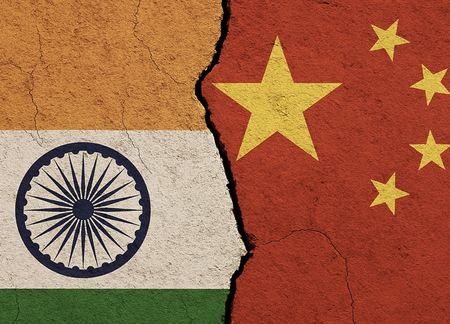
Washington, Feb 18 (IANS) China’s expanding military footprint, economic leverage, and technology dominance are sharpening India’s strategic anxieties, top American and Indian experts told a U.S. congressional commission on Tuesday, warning that New Delhi’s rivalry with Beijing remains structural despite a recent diplomatic thaw.
Testifying before the US-China Economic and Security Review Commission, academics, think tank experts, and former officials stated that the October 2024 disengagement along the Line of Actual Control had reduced immediate tensions but not altered the broader balance of power.
“Despite efforts to bring the temperature down due to uncertainty, India will continue to regard China as an adversary and remain locked in competition with China due to territorial, political, economic, and technological concerns,” Sameer Lalwani told the panel.
The border, he said, “remains highly militarised and the military balance favours China”.
Chinese infrastructure build-up in Tibet and along disputed sectors has continued even after disengagement. Lalwani warned that “a political crisis—including a Dalai Lama succession crisis—could inadvertently or deliberately escalate into a large-scale conventional conflict”.
Tanvi Madan of the Brookings Institution described the current moment as a “tactical thaw rather than a strategic reset” in Sino-Indian ties. She said “India’s structural rivalry with its largest neighbour persists”, with minimal trust in Beijing after the 2020 border crisis.
India’s threat perception has expanded beyond its borders. Beijing’s expanding footprint in South Asia and the Indian Ocean has heightened Indian concerns. China’s naval activity and economic engagement in neighbouring countries have “resulted in unprecedented Chinese strategic influence in India’s immediate neighbourhood”, said Soumya Bhowick from the Observer Research Foundation.
On the economic front, testimony highlighted India’s vulnerability to Chinese supply chains. Chandresh Harjivan told lawmakers that “China serves as the world’s primary source of bulk pharmaceuticals and chemical building blocks, while India formulates those inputs into finished medicines that supply much of the world”.
He warned that U.S. health security hinges on this interdependence.
India’s economic relationship with China, Soumya Bhowmick said, is “managed interdependence under strategic competition”. New Delhi seeks to keep commercial channels open while building “guardrails around sensitive nodes”.
At the same time, experts stressed that India sees the United States as central to balancing China. Lindsey Ford of the Centre for a New American Security said, “Neither India nor the United States can balance China alone”. She urged Congress to accelerate defence and technology cooperation to reinforce deterrence.
Tarun Chhabra, a former U.S. official, described India as “the single most important swing state in the global technology competition with the Chinese Communist Party”. He argued that India’s choices on supply chains, standards, and digital infrastructure “will materially shape whether the broader Indo-Pacific operates within a democratic technology ecosystem or a Chinese one”.
Despite renewed dialogue between PM Modi and Xi, the hearing underscored that competition—not rapprochement—defines the trajectory.
Since deadly clashes in Galwan in 2020, India has strengthened military deployments along the border and deepened security ties with the U.S., Japan, and Australia through the Quad. China, meanwhile, has accelerated infrastructure and missile deployments in its Western Theatre Command.
–IANS
lkj/dan