
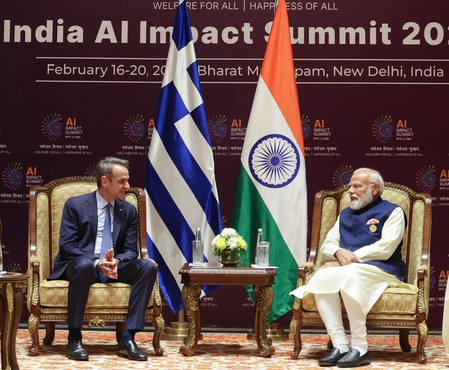
New Delhi, Feb 19 (IANS) Prime Minister Narendra Modi and his Greek counterpart Kyriakos Mitsotakis on Thursday held a meeting on the sidelines of the ongoing AI Impact Summit in New Delhi, also holding discussions on boosting connectivity especially through India–Middle East–Europe Economic Corridor (IMEC).
It was on the sidelines of the G20 Leaders’ Summit held in New Delhi in 2023 that the leaders of India, European Union, France, Germany, Italy, Saudi Arabia, UAE and US announced an MoU committing to work together to develop a new India-Middle East Europe Economic Corridor (IMEEC).
The IMEEC will comprise two separate corridors, the east corridor connecting India to the Gulf and the northern corridor connecting the Gulf to Europe. The corridor intends to enhance connectivity, increase efficiency, reduce costs, secure regional supply chains, increase trade accessibility and generate jobs, resulting in a transformative integration of Asia, Europe and Middle East.
According to the Ministry of External Affairs (MEA), during their meeting on Thursday, the two leaders reviewed various aspects of India-Greece strategic partnership, especially in the field of trade and commerce, defence and security, tourism, culture and collaboration in AI and other emerging technologies.
“The leaders discussed boosting connectivity especially through IMEC and looked forward to the early implementation of India-EU FTA which will bring immense benefits to the economy of both countries and lead to higher tech collaboration, investments and jobs, particularly for the youth. Prime Minister thanked PM Mitsotakis of Greece for his strong support to India in its fight against terrorism,” the MEA stated after the meeting.
Earlier, in his address at the AI Impact Summit, the Prime Minister of Hellenic Republic thanked India for organising the “very important” event, which has placed India and the Global South at the heart of global conversation on Artificial Intelligence (AI).
“The context you have chosen for this summit, on the theme of ‘People, Progress and Planet’, reflects the fact that Artificial Intelligence is not only a profound, massive technological change, but also a cultural change. The choices we make today will determine whether artificial intelligence will expand opportunities or deepen inequalities,” said Mitsotakis.
He mentioned that governments must ensure that workers are retrained, small businesses have access to AI tools, public services are upgraded, farmers, nurses, teachers and small entrepreneurs should feel the benefits of this technology in a tangible way.
“Concerns about the displacement of a significant part of the workforce are reasonable and must be addressed as soon as possible. In Greece, we are moving in this direction as digitalization has made public services much more accessible. The integration of artificial intelligence in education will contribute to reducing the learning gap, while advances in telemedicine, predictive analytics and personalized preventive care are making healthcare much more proactive, shifting it from treatment in hospitals to prevention at home and improving the quality of life of all citizens,” he added.
He also stated that Greece has built partnerships with all major cloud service providers, while at the same time developing its own capabilities through EU-backed AI factories and initiatives, led by national champions, attracting investment from around the world.
“A world in which technology is harnessed to pressure trusted partners or in which overregulation becomes a tool to stifle innovation is a world in which collective innovation declines. If we fragment the AI ecosystem into rigid compartments, we reduce the benefits for everyone. If we harness interdependence responsibly, we expand opportunities for everyone,” remarked Mitsotakis.
“As I listened to the Prime Minister of India, I thought that it is the combination of artificial intelligence and ancestral intelligence, whether it is found in ancient Sanskrit texts or in the writings of Greek philosophers, that will ultimately lead us to a more just future, with prosperity. This is the message that Greece wants to send to the world, and I hope it resonates,” he concluded.
–IANS
/as