
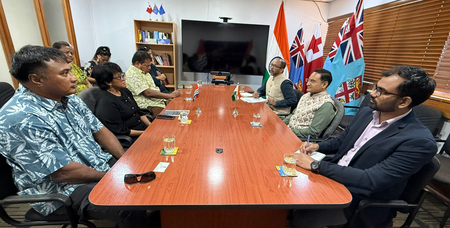
Suva, May 27 (IANS) India and Kiribati on Wednesday discussed ways to further strengthen cooperation in copra and coconut oil development.
The discussions were held during a meeting between India’s High Commissioner to Fiji Suneet Mehta and a delegation from Kiribati led by Minister for Tourism, Commerce, Industry and Cooperatives Tangariki Reete in Suva.
“High Commissioner Suneet Mehta was honoured to meet with delegation from Kiribati led by Minister for Tourism, Commerce, Industry and Cooperatives Hon. Tangariki Reete in Suva today,” the Indian High Commission in Fiji posted on X.
“Productive discussions were held focussing on their recent visit to India and exploring avenues to further strengthen India-Kiribati cooperation in copra and coconut oil development, reaffirming the growing partnership between our two countries,” it added.
The concurrent accreditation of Kiribati was transferred to Indian High Commission in Suva in October 2011. Prior to that, High Commission in Wellington was concurrently accredited to Kiribati from September 1992.
In March last year, India sent a six-bedded container-based Dialysis Unit to Kiribati.
“Standing together with the Pacific Islands family – helping strengthen the healthcare system of Kiribati. Fulfilling India’s commitment made at FIPIC III Summit: a consignment of 6-bedded container-based Dialysis Unit departed from Mundra Port for Tarawa, Kiribati,” Ministry of External Affairs (MEA) spokesperson Randhir Jaiswal had posted on X then.
Indian government provides annual grants for community development projects in Kiribati. Furthermore, training slots are offered to Kiribati under the Indian Technical and Economic Cooperation Programme of the Government of India. Diplomats are also offered training at the Foreign Service Institute of India, according to the MEA statement.
In 2017, India gave a grant of USD 1.1 million to Kiribati for solar lighting of the South Tarawa district. The project has benefited the households in the urban district who did not have access to electricity or power and are forced to resort to the use of fossil fuel for their lighting needs.
–IANS
akl/as