
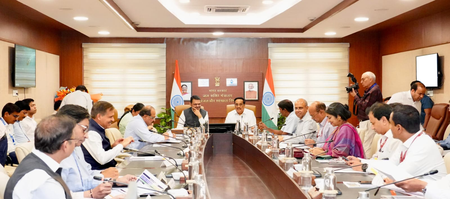
New Delhi, May 27 (IANS) A high-level delegation led by Chief Minister Devendra Fadnavis, comprising ministers and sugar industry leaders, on Wednesday sought the Centre’s intervention to bail out the sugar industry reeling under a heavy financial crisis.
CM Fadnavis, along with former Cooperation Minister Dilip Walse Patil, made a slew of demands during a meeting with Union Minister of Cooperation Amit Shah. These included the introduction of a special scheme by the Centre for loan restructuring for the sugar industry, a hike in Minimum Selling Price (MSP), 100 per cent allocation to the Maharashtra sugar industry for the procurement of 424 crore litres of ethanol annually by the oil marketing companies, dual pricing for bulk sugar and household sugar consumers, linking Fair and Remunerative Price (FRP) and MSP. They also demanded the lifting of the ban on sugar exports.
The delegation said the MSP of sugar should be increased from the current Rs 31 per kg to Rs 43 per kg. Due to continuous increases in sugarcane harvesting, transport, fuel, chemical, labour, and financial costs, the production cost of sugar in the upcoming season is likely to remain above Rs 43 per kg.
An increase in the MSP will strengthen sugar mills’ financial positions and ensure timely payments to farmers. Given current retail sugar prices, this adjustment is unlikely to have a major impact on the Consumer Price Index. Conversely, it could generate additional Goods and Services Tax (GST) revenue for the government, the delegation said.
The rise in MSP is essential, as the sugar industry is currently undergoing a severe financial crisis. Currently, the MSP for sugar is fixed at Rs 31 per kg, whereas the actual cost of sugar production has risen to approximately Rs 42-43 per kg due to continuous increases in the FRP of sugarcane, wages, energy, transport, fuel, chemicals, and financial expenses. This cost has also been verified by chartered accountants. As a result, sugar mills are facing continuous economic losses.
In 2018-19, the sugarcane FRP was Rs 2,750 per tonne, which increased to Rs 3,650 per tonne in 2026-27. This means that since the last MSP revision, the FRP has increased by about 29.49 per cent, while the sugar MSP has not been increased so far. This is causing continuous financial pressure on sugar mills, the delegation said.
Further, in view of continuous fluctuations in crude oil prices and international instability amid current global conditions, the Ethanol Blending Programme has become crucial for national energy security, helping reduce dependence on imported crude oil.
For this purpose, the Government of India had fixed distinct prices for ethanol derived from C-Heavy Molasses, B-Heavy Molasses, and Sugarcane Juice/Syrup, with the expectation that ethanol prices would be revised periodically in line with increases in sugarcane FRP, stated the delegation.
Sugar mills have invested heavily in setting up ethanol plants to contribute significantly towards achieving the government’s 20 per cent ethanol blending target. However, costs for sugarcane, labour, transport, fuel, chemicals, and other operational expenses are rising continuously, while procurement prices for ethanol have not seen the expected revision. This makes ethanol production from B-Heavy Molasses and Sugarcane Juice/Syrup financially unviable.
“Therefore, we humbly request that the price of B-Heavy Molasses-based ethanol be fixed at Rs 67 per litre and Sugarcane Juice/Syrup-based ethanol at Rs 72 per litre to maintain economic viability, strengthen the blending programme, and ensure timely payments to farmers,” said the delegation.
According to the CM-led delegation, a balanced and equitable allocation between sugarcane-based and grain-based ethanol must be ensured. The Ethanol Blending Programme was initially launched primarily to support the sugar industry and find a better utilisation route for surplus sugar. In the early years, the sugar industry accounted for nearly 90 per cent of the total ethanol supply, but today the share of sugarcane-based ethanol has fallen below 30 per cent. As a result, the large ethanol production capacity installed by sugar mills remains underutilised.
The delegation said: “We request that a sufficient, balanced, and equitable allocation be granted to sugarcane-based ethanol units to optimise installed capacities and safeguard the interests of mills and sugarcane farmers. Cooperative sugar mills are owned by the farmers themselves; any additional profit from ethanol sales ultimately returns to them as higher sugarcane prices. Therefore, the Government of India’s policy to prioritise cooperative sugar mills in ethanol allocation is highly farmer-centric, and we request that this arrangement be continued in the future.”
Given the current financial situation, it is necessary to restructure all outstanding loans to cooperative sugar mills as of March 31, 2026. Sugar mills should be granted a two-year moratorium period and a repayment period of 10 to 12 years. Additionally, interest subvention should be provided on the lines of SEFASU and previous soft loan schemes to strengthen the financial status of mills and ensure the timely payment of sugarcane arrears, stated the delegation.
Pre-existing export contracts are being adversely affected due to the recently imposed restrictions on sugar exports. This is likely to hurt international trade relationships and increase financial pressure on sugar mills.
“We request that permission be granted for sugar exports that were contracted prior to the restrictions for the 2025-26 season so that mills can honour international commitments and maintain the cash flow required for paying farmers,” demanded the delegation.
“Due to these ongoing financial conditions, cooperative sugar mills remain under heavy economic stress. While most mills are making every effort to pay farmers on time by prioritising their interests, they face immense difficulties in clearing payments for employees, transporters, vendors, contractors, and banks due to restricted cash flows. Consequently, outstanding dues to sugarcane farmers have risen to over Rs 10,000 crore, which is a matter of grave concern,” said the delegation.
CM Fadnavis and Walse Patil said the Union Cooperation Minister assured them he would sympathetically look into the issues raised by them and take action in the next 10 days.
–IANS
sj/dan