
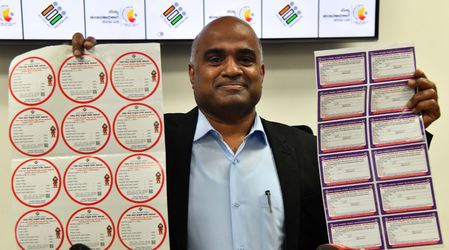
Bengaluru, June 30 (IANS) The Special Intensive Revision (SIR) of the electoral rolls commenced across Karnataka on Tuesday, with more than 59,000 Booth Level Officers (BLOs) launching a month-long door-to-door verification exercise aimed at ensuring the state’s electoral rolls remain accurate, complete and up to date.
Chief Electoral Officer V. Anbu Kumar personally filled out his Enumeration Form in Bengaluru and urged all eligible voters to complete the process. He said the door-to-door campaign had begun across the state and appealed to citizens to cooperate with election officials.
Karnataka is among 16 states and three union territories where the Election Commission of India (ECI) is conducting the Special Intensive Revision, with October 1, 2026, as the qualifying date.
The house-to-house enumeration exercise will continue from June 30 to July 29. During this period, BLOs will visit every household in their assigned polling areas to distribute Enumeration Forms to electors whose names appear in the electoral roll as of June 16, 2026.
The exercise involves an extensive administrative network, including 31 District Election Officers, four Additional District Election Officers, 224 Electoral Registration Officers (EROs), 336 Assistant Electoral Registration Officers (AEROs), 7,556 BLO Supervisors and 59,050 Booth Level Officers. In addition, 1,15,112 Booth Level Agents (BLAs) appointed by recognised political parties have also been deployed.
Karnataka currently has 5,54,32,314 registered electors, as per the electoral roll published on June 16, all of whom will be covered under the Special Intensive Revision.
During the verification exercise, BLOs will distribute Enumeration Forms and paste colour-coded stickers on households to indicate the status of the visit. A violet square sticker will signify that the Enumeration Form has been distributed, while a red circular sticker will indicate that the house was found locked during the visit.
After electors complete and sign the forms, BLOs will collect them for digitisation. Officials said BLOs will make at least three visits to households, wherever necessary, to ensure maximum collection of completed forms.
According to the schedule announced by the Election Commission, the draft electoral roll will be published on August 5, followed by one month for filing claims and objections until September 4. After the disposal of all claims and objections, the final electoral roll will be published on October 7.
Meanwhile, Karnataka Minister for Home Priyank Kharge said the State Cabinet supports a transparent and evidence-based revision of electoral rolls but has expressed serious concerns over what it described as “opacity, arbitrariness and the possibility of voter disenfranchisement” under the current SIR framework.
In a media statement, Kharge said the Cabinet had resolved that before the Special Intensive Revision is implemented in Karnataka, the Election Commission of India should conduct a full independent review of the process, including its legal basis, deletion criteria, supervisory structure, software systems and safeguards.
He also urged the Commission to extend the timeline for submission of Enumeration Forms to at least three months to reduce pressure on Booth Level Officers and the administration.
Kharge further demanded that the Election Commission publish a comprehensive manual explaining all discrepancy criteria, including “logical discrepancies”, the algorithms and software used, standard operating procedures, the officials responsible for decision-making and the list of documents required.
He said no voter should be challenged or issued a notice without prior field verification by a Booth Level Officer, and that minor spelling, clerical or transliteration errors should not become grounds for objections.
The Minister also sought guarantees that no existing voter would be removed from the electoral roll without prior notice, an opportunity for a hearing before an impartial authority and a reasoned order. He urged the Commission to clarify the complete list of admissible documents, reconsider the exclusion of Voter ID cards and Aadhaar, recognise Karnataka’s Kutumba ID wherever applicable and ensure that the burden of proof is not unfairly shifted onto ordinary citizens.
Kharge further called upon the Election Commission to process valid Form-6 applications alongside Form-7 objections, prevent bulk objections that could result in large-scale deletions and place machine-readable daily data relating to notices, additions, deletions and orders in the public domain.
He also demanded that no opaque artificial intelligence tools be used during the revision process and that all software used for data entry, digitisation, mapping and verification be publicly disclosed and independently audited.
The Minister further sought a clear definition of the roles of Special Roll Observers and Micro-Observers while ensuring that Electoral Registration Officers continue to exercise their statutory powers independently. He also called for special safeguards for women, migrant workers, slum dwellers, nomadic and denotified tribes, widows, persons with disabilities, orphans and transgender persons.
“The Karnataka Cabinet has made it clear that the state supports revision of electoral rolls, not subversion of electoral rolls. The Election Commission of India is yet to respond to these concerns,” Kharge said.
–IANS
mka/dpb