
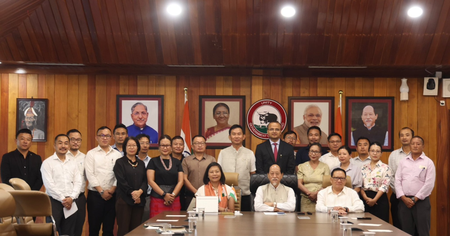
Kohima, Aug 7 (IANS) Nagaland Chief Minister, Neiphiu Rio, on Friday paid tribute to the state’s weavers, particularly women, describing them as the backbone of the handloom sector and lauding their invaluable contribution to preserving the state’s rich traditional textiles and cultural heritage.
Virtually inaugurating the Chief Minister’s Yarn Bank Scheme in Dimapur on the occasion of the 12th National Handloom Day, the Chief Minister appreciated weavers’ dedication, perseverance and extraordinary craftsmanship in preserving the state’s rich textile heritage despite changing times.
Rio described the initiative as a landmark step towards strengthening Nagaland’s handloom sector and improving the livelihoods of thousands of weavers across the State.
He said that National Handloom Day is not merely a celebration of a traditional craft but a tribute to a living heritage that has shaped the identity, culture and spirit of the Naga people for generations.
The Chief Minister said handloom represents the artistry, resilience and creativity of the people, with every shawl, wrap and woven motif carrying the stories, traditions and values of the various Naga tribes.
Acknowledging the challenges faced by weavers, Rio said access to good-quality natural yarn at affordable prices has remained a major concern.
Many artisans have been forced to travel long distances to procure raw materials, bear high transportation costs and pay inflated prices, affecting productivity, reducing incomes and limiting the growth of the sector.
To address these challenges, the Chief Minister formally launched the Chief Minister’s Yarn Bank Scheme, established as a dedicated and centralised facility at the District Industries Centre, State Industrial Park, in Dimapur, state’s main commercial hub.
He said the Yarn Bank will serve as a reliable source of high-quality natural yarn for weavers across Nagaland.
Under the scheme, natural yarns including cotton, eri silk, muga silk, bamboo fibre and other natural fibre blends will be made available at mill-gate prices.
In addition, the Nagaland government will provide a 15 per cent subsidy, making quality raw materials more affordable and accessible to eligible weavers.
Rio informed that the scheme is expected to benefit between 5,000 and 10,000 weavers every year. Eligible weavers holding a Yarn Pass Book will be able to procure yarn directly from the Yarn Bank through a transparent, reliable and efficient distribution system.
The Chief Minister said the initiative is much more than a supply mechanism. It reflects the government’s commitment to standing with the weavers of Nagaland by reducing the cost of essential raw materials, ensuring timely availability of quality yarn and creating better opportunities for artisans to improve productivity and household incomes while preserving the state’s traditional textile heritage.
He further stated that the initiative is part of the Government’s broader vision of preserving Nagaland’s cultural heritage while creating sustainable economic opportunities.
Supporting the handloom sector, Chief Minister said, will strengthen the rural economy, empower women, promote entrepreneurship and protect one of Nagaland’s greatest cultural assets.
Calling upon eligible weavers across all districts to take full advantage of the scheme, Rio also urged government departments, cooperative societies, self-help groups, village institutions and community leaders to work together to ensure that the benefits reach every deserving artisan.
On the occasion of National Handloom Day, the Chief Minister appealed to the people of Nagaland to renew their collective commitment to protecting, promoting and celebrating the State’s handloom heritage so that the traditions passed down through generations continue to inspire future generations.
Rio expressed confidence that the Chief Minister’s Yarn Bank would become a lasting support system for the handloom community and further strengthen Nagaland’s rich weaving tradition.
–IANS
sc/rad