
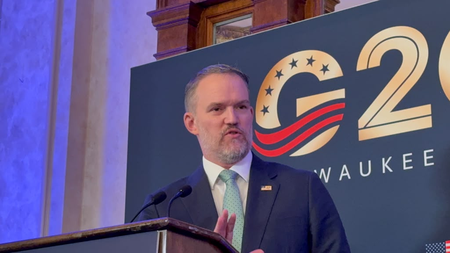
Milwaukee, Oct 2 (IANS) President Donald Trump has “essentially remade” the global trading order in a year, using tariffs and reciprocal trade agreements to rebalance US trade and secure greater market access, US Trade Representative Jamieson Greer said.
Greer said the Trump administration had secured trade deals covering more than 40 per cent of US goods trade and negotiations were continuing with additional partners.
“In just one year, President Trump has essentially remade a global trading order by imposing tariffs in pursuit of reciprocal treatment and balanced trade, and also addressing unfair trading practices that put American workers and producers at a disadvantage and have for many years,” Greer told reporters after the G20 Trade Ministers’ Meeting in Milwaukee.
“Here at the G20, we have furthered our negotiations with key partners as the world coalesces around an emerging trade, trade order led by the United States,” he said.
Greer said the United States had signed 10 agreements on reciprocal trade and nine joint statements with trading partners.
“Negotiations remain ongoing with many more trading partners,” he said.
The agreements had opened markets by reducing tariff and non-tariff barriers affecting US industrial and agricultural exports, Greer said. They were also intended to strengthen supply chains and economic security.
Greer cited automobiles, pharmaceuticals and digital trade as examples.
“As a result of our trade negotiations, 14 countries have agreed to accept US motor vehicle standards that makes it easier to export vehicles to the world,” he said.
Ten countries had agreed to accept US Food and Drug Administration approvals for new treatments and medicines, while 52 had agreed not to impose duties on electronic transmissions, he said.
Greer contrasted those results with what he described as the inability of the World Trade Organization to deliver comparable outcomes.
“With all of this, what the World Trade Organization could not deliver for America over decades, President Trump’s trade deals have delivered in the past year,” he said.
Greer said the administration was using trade policy to restore domestic manufacturing, rebalance trade and expand markets for American exports.
He also pointed to US exports of more than $1.4 trillion in goods through July and said the country was on track for its highest annual goods exports.
Greer defended the administration’s approach when asked about Canada and its efforts to expand trade relationships with India and the European Union.
Canada already had numerous trade agreements, including a comprehensive agreement with the European Union, he said.
“Our trade policy is not focused on any one country,” Greer said. “We just talk about domestic, domestic policy, domestic economic policy.”
Greer said Washington had no objection to Canada or other countries seeking additional markets for their production.
“So when people talk about Canada and the European Union somehow finding more demand in their countries, I mean, these are very low-growth jurisdictions, and low-growth plus low-growth is still low-growth,” he said.
“So we are actually totally fine with countries trying to find other people to take their surplus production.”
Greer said US technical discussions with Canada were continuing, but significant differences remained.
“We certainly have technical talks with the Canadians,” he said. “The reality is there are a handful of outstanding issues that are quite difficult to resolve.”
The comments came after a reporter noted that Canada had been holding meetings with India and the European Union during the Milwaukee ministerial while its negotiations with Washington remained unresolved.
The United States is hosting the G20 in 2026, with trade policy forming a major part of its agenda. The Milwaukee ministerial brought together representatives of major advanced and emerging economies ahead of the G20 Leaders’ Summit in Miami later this year.
–IANS
lkj/rs