
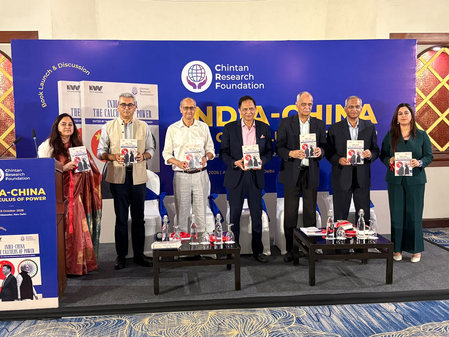
New Delhi, Oct 15 (IANS) As India and China negotiate a relationship in which technological and economic competition coexists with the imperatives of interdependence and regional stability, experts have offered an economic overview of the India-China relationship, describing the relationship as an evolving equation shaped by border tensions, public mistrust and trade asymmetries — cautioning that economic interdependence could become a strategic vulnerability amid persistent uncertainty.
Shishir Priyadarshi, President of the Chintan Research Foundation (CRF), called for a balanced assessment of both countries’ perspectives, moving beyond conventional narratives to the full spectrum of engagement, competition and cooperation.
The CRF, in its endeavour to contribute to the field of China studies, brought together a collection of essays on the emerging calculus of power between the two Asian giants in the national capital.
The accompanying discussion examined the dominant strands of discourse and narrative behind the change that India and China are likely to experience in the coming decade, and the norms and ethos that will shape their relationship in the years ahead.
China, through its emphasis on multi-polarity, has tried to forge a new world order where the equilibrium has titled to a more “first amongst equals” world-view. This sits uneasily with India’s desire to be treated at par.
In his foreword for the book, Amb. Ashok Kantha notes that the two countries’ parallel national ambitions are structurally incompatible, complicating efforts to build mutual trust.
However, the strategic calculus is still not fixed and is under recalibration where India’s choices on economic and technological development will shape the future balance of power.
The relationship, therefore, needs to navigate economic coexistence alongside strategic competition. The book thus treats India–China relations not as a choice between engagement and confrontation, but as a continuous negotiation between the imperatives of economic coexistence and the realities of strategic competition.
During his comments on the book, Prof. Srikanth Kondapalli drew on historical anecdotes, recalling the three conditions China raised with K. R. Narayanan in the 1990s, one of which included a commitment to the “One-China principle” and its non-negotiability.
He stressed the need to strengthen India’s scholarship on China through greater research funding, Chinese-language training and academic exchanges, and to assess both nations’ power comprehensively to inform strategic decision-making.
Limited diplomatic reciprocity and differing strategic perceptions, he noted, continue to hold back the relationship. He concluded with a call for greater institutional support for young scholars and for field research in China to deepen understanding of its political, strategic and diplomatic landscape.
Turning from perceptions to power, Prof. Kanti Bajpai highlighted China’s advantages in manufacturing, infrastructure, technology and defence production, while identifying India’s demographic strength, geographical position, Indian Ocean presence, diplomatic partnerships and growing economy as key sources of leverage.
He advocated a stable but competitive relationship grounded in border negotiations, high-level engagement, confidence-building measures and economic ties. He also flagged risks arising from Tibet, China–Pakistan cooperation, technological competition and critical minerals, emphasising the importance of assessing regional power shifts and the evolving military and economic balance highlighting 2035, 2050 and 2060 as the years to watch out for – in the near future.
Deep Pal identified economic and technological cooperation as potential avenues for engagement despite persistent security tensions. He cautioned that India’s dependence on Chinese imports, particularly in electronics, critical technologies and manufacturing components, risked becoming a strategic vulnerability.
He called for import diversification, improved market access for Indian businesses in China and greater cross-border exchanges, stressing that bilateral economic ties must be assessed against the wider backdrop of US–China competition, export controls and global trade fragmentation.
Shubhangi Sharma examined how competing historical claims and territorial perceptions reinforce the India–China security dilemma, with measures intended to enhance one country’s security often deepening the other’s concerns.
She highlighted how these narratives shape media portrayals and argued that Indian journalism remains constrained in its ability to project power and interpret China due to logistical obstacles and the lack of opportunities to engage in a constructive discourse. She called for greater field exposure for Indian journalists to understand China’s society, culture and people, and to foster a more nuanced understanding of its culture and people.
—IANS
na/