
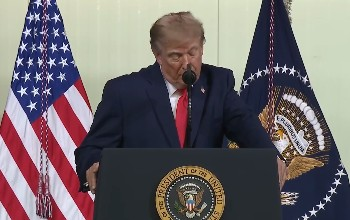
Washington, Nov 10 (IANS) US President Donald Trump said he was open to an immigration agreement with Democrats but ruled out amnesty, while backing a bipartisan permitting bill and insisting he would not approve wind turbines.
Speaking at an impromptu White House press conference, Trump offered few details on a possible immigration compromise. His remarks came during a wide-ranging exchange that also covered military operations, election disputes and Cuba.
Asked whether he could reach a deal with Democrats on immigration, Trump said: “We’re not going to have amnesty or anything.”
He said people would have to follow the proper process, arguing that doing otherwise would be unfair to others. He did not outline eligibility rules, a timetable or the terms he would seek in negotiations.
The exchange followed questions about Stephen Miller and what policy changes he had made. Trump praised Miller, saying he had been with him from the beginning and could work with the opposition.
“He’s smart, he’s tough, he’s fair, and he actually will get along, I think, very well with the Democrats.”
The prospect of cooperation with Democrats also surfaced in questions about a permitting bill that a reporter said was expected to face a vote that night.
“The permitting bill is a great bill that’s supposed to be bipartisan. We — we are behind it 100 per cent,” Trump said.
He was less definite when asked whether he would press House members to support it. Trump said Democrats wanted the measure as much as Republicans, while allowing that their position might have changed.
His support came with an objection. Asked whether he would approve wind turbines, which a reporter described as a key part of the bill, Trump replied: “No, I will not approve wind turbines.”
When pressed on the apparent conflict, he said the bill had not been fully negotiated. He did not explain how his opposition would be accommodated in the legislation.
Trump also defended Pete Hegseth against criticism, crediting him with military successes in Venezuela and Iran. He described the Venezuela operation as lasting 48 minutes and claimed nobody had been killed.
On Iran, Trump said he believed the war had been won. He asserted Iran’s navy and air force had been destroyed and that Tehran wanted a deal. The supplied transcript contains no independent evidence supporting those assessments.
Trump linked the Iran campaign to preventing the country from acquiring a nuclear weapon. He acknowledged that public concern about energy costs could carry a short-term political cost and promised prices would come down.
Turning to Cuba, he described the country as failing and said the United States was providing humanitarian help. Asked about his earlier remarks on taking Cuba, he gave no specific commitment or operational details.
Immigration has long divided US politics. Disputes have centred on border enforcement, asylum, legal entry and the status of people living in the country without authorisation. Broad changes to immigration law require action by Congress, making negotiations between the White House and lawmakers important to any legislative agreement.
Federal permitting governs approvals for many energy and infrastructure projects. Efforts to change that process have involved competing priorities, including faster construction, environmental safeguards and the treatment of different energy sources. Wind power has been one of the technologies at the centre of the wider US debate over energy policy.
–IANS
lkj/rs