
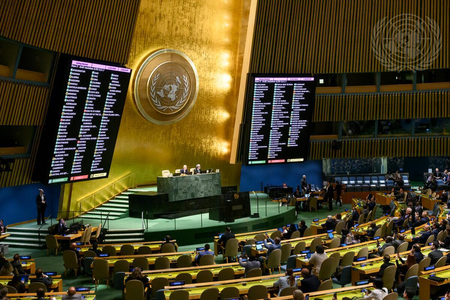
New Delhi, Sep 28 (IANS) Despite renewed international concern over Afghanistan at the 81st United Nations General Assembly (UNGA) in New York, a critical question continues to linger: when will the global community move beyond expressions of concern and invest in a durable political settlement for the war-torn country?
The international community, including India, has expressed concern about restrictions on women’s rights, education, and other human rights under Taliban rule. The regime has not received broad international recognition so far, except from Russia.
The United Nations has also not accepted the Taliban’s claim to represent Afghanistan at the world forum. India and a few countries have, while withholding formal recognition, maintained contacts with Kabul – providing humanitarian assistance and developmental support – to ensure protection of national and regional interests.
New Delhi has also stressed the Taliban’s assurance that Afghan territory will not be used for activities threatening regional security. Thus, food, medicines, vaccines, and other essential supplies have been provided to help the Afghan people cope with challenges such as conflict, political instability, and natural disasters.
India has also invested in infrastructure, education, healthcare, and capacity-building projects in Afghanistan, contributing to the country’s socio-economic development. Through its outreach, New Delhi has emphasised that its assistance is directed toward the welfare of the Afghan people, reflecting its commitment to regional stability, peace, and humanitarian cooperation.
Commenting earlier this month on the Afghan situation and its implications for international peace and security, a UN statement this month noted, “Food insecurity, malnutrition and public health concerns persisted, while operational constraints, funding gaps and restrictions affecting women humanitarian workers continued to impede the delivery of assistance”, adding, “Humanitarian needs remained acute amid severe funding shortages”.
And thus, “The 2026 Afghanistan Humanitarian Needs Response Plan remained significantly underfunded, at 29.9 per cent ($513 million of $1.7 billion required),” it stated.
In this statement, UN Secretary-General António Guterres also pointed to Taliban policies raising serious human rights concerns, “including denial of rights affecting women and girls, restrictions on both men and women, arrests of journalists, reported violations of the general amnesty protecting members of the previous Government, and the continued imposition of corporal punishment”.
It further noted border skirmishes and Pakistan Air Force bombing deep inside Afghan territory, with the hostilities causing “399 civilian casualties (57 killed and 342 injured) in Afghanistan between April 1 and June 30”, it added.
In an earlier interview to an Afghan newspaper, Naseer Ahmad Faiq, the acting Chargé d’Affaires of Afghanistan’s Permanent Mission to the United Nations, said that Taliban authorities contacted him through his former colleagues in Kabul’s Foreign Ministry and even directly to seize Afghanistan’s seat in the world body.
He, however, reportedly emphasised “the interests of the people, respect for human rights values, especially women’s rights, and legitimate sovereignty”.
At UNGA 81, Faiq argued in a high-level side event that Afghan women should not be viewed merely as victims but as political stakeholders whose meaningful participation is essential for any sustainable peace process. He stressed that Afghanistan’s crisis cannot be reduced to humanitarian aid or the reopening of girls’ schools alone, important as those goals are.
He called for a comprehensive political approach rooted in justice, accountability, inclusion, and national reconciliation. The side event on “Women, Peace, Justice and National Reconciliation in Afghanistan”, organised by the Princeton School of Public Service and International Affairs, also emphasised that sustainable peace requires legitimate institutions, respect for human rights, accountability, social trust, and meaningful participation by women and diverse political stakeholders.
It warned that progress toward an inclusive settlement remains elusive despite years of international engagement.
Meanwhile, many leaders speaking in the General Debate returned repeatedly to themes of sovereignty, multilateralism, international law, and peaceful resolution of disputes. The statements are welcome, but the global community needs to address the gap between observation and international execution.
The world has spent years expressing concern about Afghanistan. It has passed resolutions, issued declarations, held conferences, and convened dialogues. Yet millions of Afghans remain trapped in economic hardship, women continue to face severe restrictions, and the country remains politically isolated.
The uncomfortable truth is that Afghanistan is caught in a cycle of concern without urgency, with conflicts elsewhere dominating regional diplomatic agendas and security concerns. For India, it remains a clear and imminent danger that needs to be addressed pragmatically.
–IANS
jb/skp