
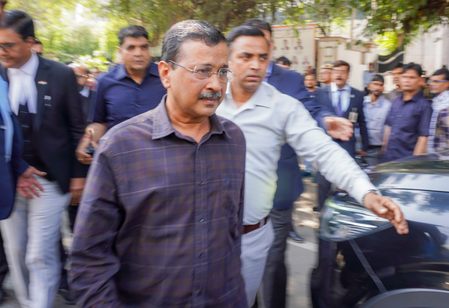
New Delhi, Feb 27 (IANS) The Rouse Avenue Court in the national capital on Friday discharged AAP national Convenor Arvind Kejriwal and his closest aide Manish Sisodia, along with 23 others in the excise policy case, also called liquor policy scam, clearing them of charges of alleged corruption and wrongdoing, stating that there was “no overarching conspiracy or criminal intent”.
Kejriwal and Sisodia’s acquittal in the case comes despite their incarceration for months in the case and, as expected, has elicited sharp reactions from the AAP and INDIA bloc; both have accused the ruling BJP of “unleashing” Central agencies on them for political gains.
The case pertains to the Delhi Excise Policy, formulated by the AAP government in November 2021, to revamp and bring a structural overhaul of the liquor businesses and their regulation in the national capital. Within months of policy rollout, it found itself in the throes of controversy with the BJP accusing the AAP dispensation of colluding with the liquor mafia to fill its coffers. The policy was subsequently scrapped a year later in 2022.
A case was lodged following a report by the then Chief Secretary Naresh Kumar to Lieutenant Governor (L-G) Vinai Kumar Saxena in July 2022, which pointed at multiple “procedural lapses and lacunas” in policy formulation.
The report submitted before L-G Saxena cited many “arbitrary and unilateral decisions” taken by the then minister Manish Sisodia and claimed that it resulted in “financial losses to the exchequer” estimated at more than Rs 500 crore.
The Kejriwal government, surrounded by controversy, rubbished charges of irregularity and complicity and claimed that this was done to improve customer experience and to crack down on the liquor black market.
However, the report submitted to Delhi L-G mentioned “kickbacks” and “illegal gratification” received by the AAP government and leaders from the owners of liquor businesses. It alleged that rebates and waivers of hundreds of crores of rupees were extended on licence fees.
Acting on inputs of ‘gross violations’, the L-G recommended a CBI probe.
The CBI, in its investigation, charged Manish Sisodia and other AAP leaders of gross violations, including tailoring the liquor policy to benefit wholesalers and later arrested him.
It claimed that “kickbacks” to the tune of Rs 100 crores were paid to AAP leaders by many liquor entities, including those from southern states.
“This money was diverted to fund the party’s election campaigns in Goa and Punjab, headed to Assembly polls in 2022,” it claimed.
The issue snowballed into a major controversy then, with the BJP accusing the Kejriwal government of looting the exchequer to realise the party’s political ambitions while the latter outrightly refuted the charges, blaming the BJP-led Centre of witch-hunting against AAP.
Subsequently, when the charges were framed, Arvind Kejriwal was named as the ‘key conspirator’ in the alleged scam in the CBI charge sheet, with the former Chief Minister being directly charged with formulation of the controversial policy and diverting proceeds of crime.
The then Deputy Chief Minister Manish Sisodia, who also held the Excise Minister portfolio, was charged with “arbitrary and unilateral decision-making” to benefit private liquor players.
–IANS
mr/dpb