
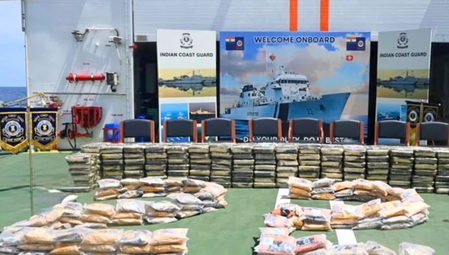
New Delhi, Oct 3 (IANS) The Rs 3,000-crore drug bust off the Lakshadweep Islands early this week has dealt a major blow to the Haji Salim network, but the bigger challenge for the alleged Inter Services Intelligence-backed syndicate is the shrinking availability of viable maritime routes into India.
Intensified coastal surveillance and heightened security have made traditional landing points increasingly difficult to use, forcing the network to shift routes, take greater risks, and search for new entry points for moving large consignments of narcotics.
Five Pakistani nationals operating the vessel were arrested, and 400 kg of methamphetamine and 126 kg of high-grade drugs worth over Rs 3,000 crore were seized during the operation by the Indian Coast Guard (ICG) and Gujarat Anti-Terrorism Squad.
An official said that the investigations show that the consignment was intended to land in Tamil Nadu, following which it was to be smuggled into international markets.
“Haji Salim, a Dawood Ibrahim aide, is in charge of narcotic smuggling into the southern states. From there it is taken to Sri Lanka and to countries such as Thailand,” the official said.
For the Haji Salim, the seizure of such a massive consignment is no doubt a setback, but the bigger worry for the syndicate is that it is running out of routes.
“Earlier, Gujarat was the most preferred route for the Haji Salim network. However, in recent times there have been multiple busts on this route, and the network has incurred massive losses following heightened security,” the official said.
The surveillance has increased manifold along the Gujarat route, and smuggling has become extremely difficult for the gang. This has forced the Haji Salim network to send the consignment of drugs using alternate routes.
Since the network shifted south, the Iranian dhow that was carrying the consignment had to be tracked and intercepted 160 nautical miles northwest of Lakshadweep.
Another official said the Haji Salim network now faces a fresh challenge as the new route has also come under the radar of coastal agencies.
“The network may have spent months planning the alternate route to bypass Gujarat. However, following the latest joint operation by the Indian Coast Guard (ICG) and Gujarat ATS, the Salim gang is likely to start looking for another route,” the official said.
The officials say that very soon, the ISI-backed Salim syndicate will run out of routes.
Earlier, the most preferred route prior to Gujarat was Vizhinjam near Thiruvananthapuram in Kerala. However, there were multiple successive actions carried out by the agencies, which led to several consignments being busted.
“Currently the surveillance at this seaport is at an all-time high and smuggling narcotics is next to impossible here,” the official said.
An Intelligence Bureau official said that Haji Salim managed to find new landing points at Kasargod and Malappuram, in north Kerala
“These locations have relatively low levels of coastal surveillance, making them ideal landing points for the network. However, it is only a matter of time before surveillance is stepped up in these areas,” the official said.
The officials say that although the Indian agencies have shut down several routes and conducted successive operations, they cannot become complacent. There is a lot at stake here, and both the ISI and the Haji Salim network are in need of funds. With so many of their contingents being busted in recent times, the losses that they have incurred is huge.
Further, Haji Salim is also under immense pressure from his international buyers to deliver narcotics in huge quantities.
If busts such as these continue to take place, then the international buyers would start looking for other avenues and this would cause a major dent for the Haji Salim network, officials say.
For the ISI too, such busts represent a major setback.
Officials said that under arrangements allegedly struck by the ISI with narcotics operators such as Dawood Ibrahim and Haji Salim, the drug cartels are required to hand over 40 percent of their proceeds from the narcotics trade. In return, the ISI is alleged to provide protection to the networks.
Officials said the money is largely used to finance terror activities in India.
The fact is that the Haji Salim network is running out of routes in India to move its consignments. While Salim plans newer routes, he also has to deal with the pressure from international buyers who are likely to pursue other avenues if this network does not get its act together, another official said.
–IANS
vn/snj/skp