
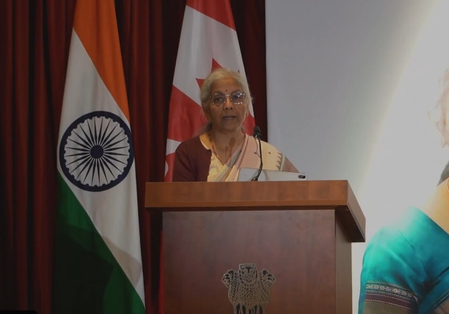
Toronto, Aug 26 (IANS) Union Finance Minister, Nirmala Sitharaman, has said that India and Canada are the “most natural partners” in the world and stressed that bilateral ties have seen a “remarkable transformation” in recent times.
Union Minister Sitharaman arrived in Toronto on Tuesday (local time) for a four-day official visit to Canada focussed on strengthening bilateral trade, investment linkages, and financial cooperation.
Speaking during a reception of the Indian diaspora business community in Toronto, the Finance Minister said, “India-Canada bilateral relations have seen a remarkable transformation in recent times, underpinned by our shared values of democracy and pluralism, and expanding economic engagement, and an unprecedented pace of high-level interactions— which the High Commissioner recalled a minute ago — and the strength of our people-to-people ties.”
Hailing the Indian business community in Canada, she said, “This is a community that sits inside Canadian boardrooms, on the trading floors of Bay Street, inside the risk committees of the pension funds. It is, in the truest sense, a strategic bridge between two vibrant democracies and two innovation-driven economies.”
She recalled the meeting between Prime Minister Narendra Modi and his Canadian counterpart, Mark Carney, on the sidelines of the G7 Summit in June 2025, and said that during that meeting both leaders agreed to reset India-Canada ties by reaffirming a “future-focussed strategic partnership”.
“This was further advanced during Prime Minister Carney’s visit to India early this year, which formally launched CEPA negotiations, a Canadian $2.6 billion uranium agreement with Cameco, the adoption of Vasudhaiva Kutumbakam as an overarching framework of the renewed strategic partnership, and a joint declaration of ambition to more than double two-way trade to Canadian $70 billion by 2030,” she added.
The Union Minister said that she believes India and Canada are the “most natural partners in the world”.
“We are both vibrant democracies wedded to the rule of law. We share the Commonwealth traditions, a similar parliamentary model, and the same official language. We see eye-to-eye on most geopolitical questions. We both champion UN-based multilateralism, North-South cooperation, and a rules-based international order. Above all, Canada and India are the two great multicultural societies in today’s world that truly value and cherish diversity. And that is a bond that goes deeper than any trade agreement,” she added.
The Finance Minister said that India today stands as the fastest-growing major economy in the world and offers a combination that is difficult to match — scale, sustained growth, a young population, expanding consumption and rapidly deepening capital markets.
“India’s transformation is structural. Rapid urbanisation, a growing middle class and world-class digital infrastructure are creating new opportunities across virtually every sector of the economy. Our digital ecosystem has also dramatically reduced the cost of access and expanded the reach of financial and commercial services,” she said.
Sitharaman said that the India-Canada partnership is “increasingly moving from capital flows to deeper institutional engagement”.
“Capital markets are only one dimension of a modern financial partnership. Equally important is the underlying financial infrastructure,” she said, hailing India’s Unified Payments Interface (UPI) system.
“There are significant opportunities here for collaboration with Canadian banks, fintech companies and regulators – not only in payments, but in shaping the next generation of digital financial infrastructure,” she added.
The Finance Minister stated that India is also creating “new gateways” for international capital.
“GIFT City, India’s International Financial Services Centre, is emerging as a global platform for international financial institutions, supported by a regulatory and tax framework designed specifically for cross-border financial activity,” she added.
At the same time, Sitharaman said that India has “progressively opened” sectors like insurance, asset management and pensions to greater foreign participation, while the Indian capital markets have become “deeper, more liquid and more sophisticated”.
For Canadian institutional investors, she said that it creates opportunities not only to participate in India’s growth, but also to “use India as a platform for wider regional and global financial activity”.
–IANS
sd/rad