
New Delhi, July 24 (IANS) Emphasising that India has consistently respected China’s sovereignty, the Ministry of External Affairs (MEA) on Friday asserted that it is Beijing that has illegally occupied Indian territories in Jammu and Kashmir and Ladakh since 1963.
Addressing a media briefing in New Delhi, MEA spokesperson Randhir Jaiswal reiterated India’s objection to Chinese infrastructure projects in these regions and maintained that New Delhi has legitimate grounds to raise concerns over sovereignty.
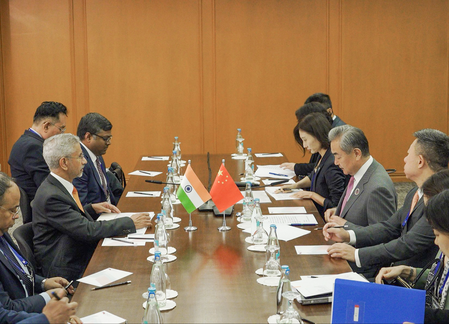
The remarks came after the Chinese Foreign Ministry, in a statement following the meeting between External Affairs Minister (EAM) S Jaishankar and China’s Foreign Minister Wang Yi in Manila, said: “India respects China’s sovereignty and has always pursued a positive and cooperative bilateral relationship with a forward-looking approach.”
Responding to a question, Jaiswal said, “The External Affairs Minister said that, when it comes to sovereignty issues, it is actually India that should be, and is, raising them. India does not violate China’s sovereignty in any manner and has been consistent. But China is in illegal occupation of Indian territories in Jammu and Kashmir and Ladakh since 1963, where India’s rights is officially acknowledged even by China. Also, there are Chinese projects on territories in Jammu and Kashmir that belong to India, and we object to that.”
In his opening remarks during a meeting with Wang Yi on Wednesday, EAM Jaishankar termed peace and tranquility in the border areas a “pre-requisite” for normal ties between India and China.
He expressed appreciation for China’s support for BRICS activities and initiatives under India’s presidency.
“Peace and tranquility in the border areas is obviously the prerequisite for normal ties. Since October 2024, both sides have engaged to ensure that important objective. This will continue to need our constant attention. Relevant mechanisms in this domain must be given full support and strong encouragement,” the EAM said.
“It is natural that as two large and important nations, and that too proximate neighbours, India and China would have their own particular interests. That is why our leaders agreed that differences should not become disputes. It is the responsibility of diplomacy to properly manage them,” he added.
The External Affairs Minister also welcomed steps taken towards normalisation, including the resumption of direct flights, updating of visa arrangements, restarting of the Kailash Manasarovar Yatra and recommencement of border trade.
–IANS
scor/as