
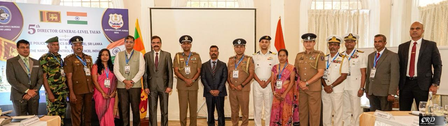
New Delhi, Sep 28 (IANS) The fifth Director General-level talks between India’s Narcotics Control Bureau (NCB) and Sri Lanka’s Police Narcotics Bureau (PNB) were held in Colombo, focusing on intelligence sharing, joint operations and fugitives, an official said on Monday.
The Indian delegation was led by R. Sudhakar, IPS and NCB Deputy Director General (Southern Region), and the Sri Lankan delegation by K.D.G.L. Ashoka Dharmasena, Head of PNB, the official said on Monday in a statement.
Priyantha Weerasooriya, Head of Sri Lanka’s Police, inaugurated the deliberations on September 23, kicking off discussions focused on maritime trafficking trends, intelligence sharing, joint operations, fugitives and coastal security.
Representatives of the Indian Coast Guard, Ministry of External Affairs and Tamil Nadu Police also participated.
The two sides discussed measures for strengthening cooperation to detect, disrupt and dismantle transnational drug trafficking networks.
Earlier, India proposed the creation of a BRICS Virtual Working Group for real-time intelligence sharing and coordinated enforcement against transnational drug syndicates at the two-day BRICS Heads of Anti-Drug Agencies meeting held in Guwahati in July under India’s BRICS Chairship 2026.
The high-level meeting brought together heads of anti-drug agencies and senior officials from BRICS member nations to strengthen cooperation against the growing global challenge of drug trafficking and substance abuse.
Addressing the inaugural session, Director General of the Narcotics Control Bureau (NCB), Anurag Garg, urged BRICS drug law enforcement agencies to forge a partnership based on speed, trust and seamless real-time intelligence sharing that transcends national borders and enables swift action against organised international drug trafficking networks.
He said that the increasing sophistication of transnational drug syndicates demands greater coordination, faster information exchange and stronger operational collaboration among BRICS nations.
Highlighting India’s anti-drug strategy under the leadership of Prime Minister Narendra Modi and Union Home Minister Amit Shah, Garg reiterated the country’s zero-tolerance policy against narcotics and outlined India’s three-year roadmap for 2026-29 based on a network-centric enforcement approach.
The strategy focuses on dismantling entire criminal networks rather than targeting isolated offenders, preventing drug abuse through large-scale awareness campaigns, and strengthening treatment, de-addiction and rehabilitation mechanisms.
–IANS
rch/khz