
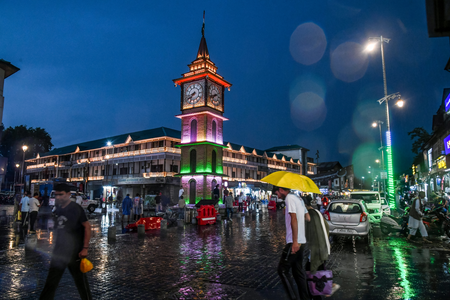
New Delhi, Aug 5 (IANS) Seven years after the abrogation of Articles 370 and 35-A, Jammu and Kashmir has witnessed significant progress in infrastructure, education, tourism and connectivity, although challenges linked to security and implementation continue, according to a report assessing the region’s transformation since August 2019.
A report by The Global Kashmir, presents what it describes as a sector-wise assessment of the Valley’s changing landscape, saying that while the political debate surrounding the Constitutional changes remains unresolved, development on the ground has gathered pace across several key sectors.
“None of this settles the larger political debate around the abrogation itself, which remains contested in Kashmir and beyond. What can be described with more confidence is the pattern of development on the ground, sector by sector,” the report said.
According to the report, one of the most noticeable changes has been in the education sector. Schools have largely remained open throughout the academic year, reducing disruptions caused by hartals, curfews and prolonged closures that had affected students for years. It noted that the academic calendar has been aligned more closely with the national schedule, while higher education infrastructure has also expanded with AIIMS Jammu becoming fully operational and work continuing on AIIMS Awantipora, alongside the approval of seven new medical colleges.
The report also highlighted the completion of the long-awaited Udhampur-Srinagar-Baramulla Rail Link, describing it as a milestone in improving connectivity. The opening of the Katra-Banihal section in early 2025 connected the Kashmir Valley with the national railway network, with Vande Bharat trains now significantly reducing travel time between Katra and Srinagar. It added that traders have begun witnessing improvements in the transportation of apples, dry fruits and handicrafts, although the long-term economic impact is still being assessed.
Tourism, another key pillar of the region’s economy, has shown both progress and setbacks, the report said.
Tourist arrivals reached a record level in 2024 before declining in the Valley following the Pahalgam terror attack in April 2025.
Despite the setback, the report noted that the government has continued to diversify tourism by developing new destinations and promoting winter sports and lesser-known circuits.
The report further pointed to improvements in road infrastructure, tunnels, drinking water supply and power connectivity, attributing much of the progress to sustained public investment. However, it also acknowledged delays in major projects such as AIIMS Awantipora, noting that difficult terrain and rising costs have slowed implementation.
On the security front, the report said Kashmir has experienced a reduction in large-scale shutdowns and street violence compared to previous years, while elections have restored an elected government in the Union Territory. At the same time, it cautioned that incidents such as the Pahalgam attack demonstrate that security gains remain vulnerable to setbacks.
“Peace in Kashmir today looks less like the total absence of violence and more like a fragile, still-developing steadiness,” the report added.
The report also highlighted the extension of several Central and Union Territory welfare schemes to Jammu and Kashmir, including initiatives related to housing, agriculture, rural infrastructure, horticulture and entrepreneurship. While acknowledging uneven implementation in some areas, it concluded that the region is undergoing a gradual transformation rather than having reached a final stage of development.
Jammu and Kashmir is “in the middle of a long, uneven rebuilding process rather than one that has arrived at a finished destination,” the report said, adding that the coming years will determine whether ongoing investments translate into lasting stability and sustained economic growth for the region.
–IANS
rs/khz