
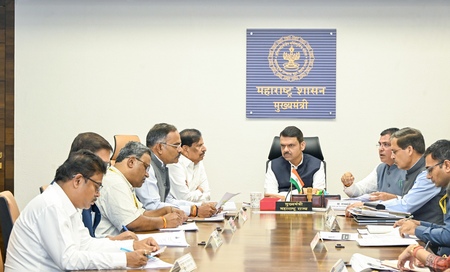
Mumbai, Nov 17 (IANS) The Maharashtra Cabinet, chaired by Chief Minister Devendra Fadnavis, on Tuesday approved key amendments to the Integrated and Sustainable Textile Policy 2023–28, including adding Palghar district to Zone-1 and relaxing expansion norms. In a separate major decision for the district, the cabinet also cleared the establishment of a Principal District and Sessions Court, a Chief Judicial Magistrate (CJM) Court, and a District Public Prosecutor’s Office in Palghar.
This followed demands from textile associations after the rollout of the new policy and Chief Minister Fadnavis’s assurance that industry-friendly revisions would be introduced.
The cabinet overhauled the zonal classification under the 2023–28 policy by abolishing Zone-4. Districts previously under Zone-2 have been shifted to Zone-1, Zone-3 districts to Zone-2, and Zone-4 districts to Zone-3.
Recognising Palghar as a tribal district, the government moved it directly from Zone-4 to Zone-1. Under the amended rules, installing additional machinery valued at 10 per cent or more of the book value of machinery installed in the previous financial year will officially qualify as “expansion”.
Textile projects that received bank loan sanctions before June 1, 2023—as well as self-financed units that made advance payments for machinery before that date—but commenced production during the 2023–28 policy period have been granted the option to choose benefits under either the 2018–23 textile policy or the 2023–28 policy, said the government release.
Further, the Cabinet approved a District and Sessions Court for Palghar. According to the government release, Palghar district was carved out of Thane on August 1, 2014, comprising eight talukas: Palghar, Vasai, Dahanu, Talasari, Jawhar, Wada, Mokhada, and Vikramgad.
Following approval from the High Court’s New Court Establishment Committee to bifurcate the Thane judicial district and create a separate Palghar judicial district, the state cabinet sanctioned the requisite judicial offices and staffing.
A total of 79 new posts will be created, while 29 posts will be transferred from existing courts. Additionally, 39 positions will be filled through outsourcing. For the Chief Judicial Magistrate Court, 16 new posts have been sanctioned, along with 3 positions to be filled through outsourcing. For the District Public Prosecutor’s Office, 5 new posts will be created, with 1 additional post to be filled through outsourcing.
–IANS
sj/dan