
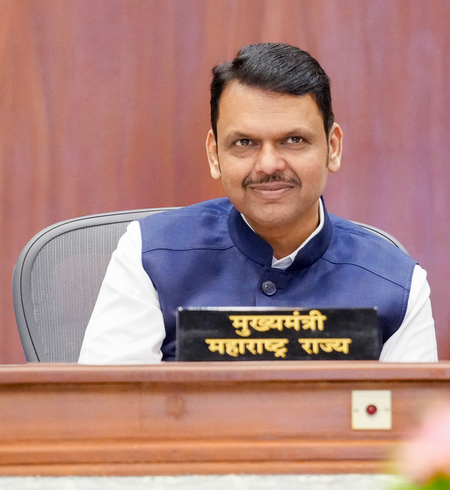
Mumbai, Aug 3 (IANS) Following security objections raised by the Indian Navy regarding height restrictions in the area, the Maharashtra state government led by Chief Minister Devendra Fadnavis has significantly revised its plans for the proposed Parivahan Bhavan (Transport Building) in Worli.
The original plan for a 16-storey high-rise has now been downsized to a structure comprising a ground floor, two podiums, and four upper floors.
The Transport Department on Monday issued a Government Resolution (GR) granting administrative and second financial approval for the revised design layout. The state government had initially planned a high-tech headquarters for the Transport Commissionerate in Worli, spanning 16 floors.
However, the clearance hit a roadblock due to strict height restrictions imposed by the Ministry of Defence and the Indian Navy given the plot’s proximity to naval installations.
To comply with defence regulations, the state government drastically scaled down the building’s elevation. Under the modified plan, the Public Works Department (PWD) will execute the construction, featuring a ground floor, two podium levels, and four storeys. The new administrative hub will consolidate various offices of the Transport Commissionerate under a single roof, aiming to streamline operations and offer modern, accessible services to the public.
The GR instructs officials to ensure absolute transparency in the tendering process, strictly adhere to the sanctioned plan, comply with environmental and safety norms, and manage expenditures within the allocated budget. The clearance of the revised layout clears a long-standing impasse, clearing the deck for actual construction on the long-delayed Parivahan Bhavan project to begin soon.
Earlier, Transport Minister and Chairman of the Maharashtra State Road Transport Corporation (MSRTC) Pratap Sarnaik had taken a series of aggressive policy measures and administrative reforms aimed at turning around the cash-strapped state transport utility. He set an explicit target to revive MSRTC from cumulative losses and restore it to profitability within two years by optimising route operations, plugging revenue leaks, and modernising asset management.
He issued a one-month performance ultimatum to depot and division officers. Officials in the 21 loss-making divisions (including Nashik, Kolhapur, Nagpur, and Thane) face strict disciplinary actions—including demotions, transfers, or suspensions—if revenue targets are not met. He approved a 5% Dearness Allowance (DA) hike for MSRTC staff (bringing DA to 58% of basic pay) to align MSRTC employees with state government standards, linking pay parity directly with operational efficiency and accountability.
He initiated reviews to upgrade rural depot infrastructure, transition older fleet units toward cleaner energy alternatives, and improve passenger amenities across MSRTC bus terminals.
–IANS
sj/uk