
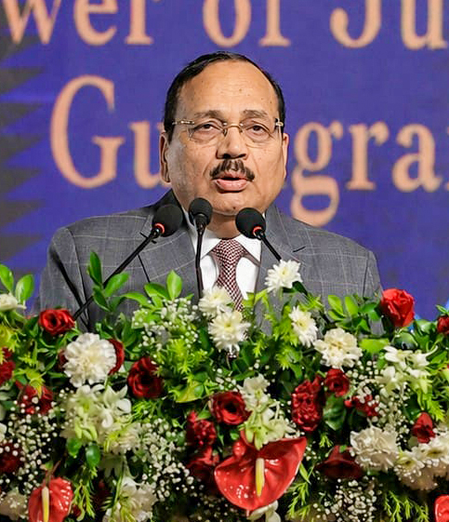
Jaipur, August 1 (IANS) Chief Justice of India (CJI) Justice Surya Kant said on Saturday that resolving disputes through mutual agreement and mediation is deeply embedded in India’s civilisational ethos, with its roots tracing back to the Vedas, ancient history, and the philosophies of Kautilya and Mahatma Gandhi.
Addressing delegates on the second day of the Commonwealth Mediation Conference in Jaipur, the CJI added that mediation has been an integral part of Indian culture long before the enactment of the Mediation Act, 2023.
He noted that both the Legislature and the Judiciary have played a significant role in strengthening the practice in recent years.
Explaining the importance of mediation, the CJI Justice Surya Kant narrated the story of two sisters disputing ownership of an orange.
Citing an example of mediation, the CJI said: “Both insisted they deserved it, the elder on the basis of seniority and the younger because she was younger. After a prolonged argument, they agreed to split the orange equally. One sister discarded the peel and ate the fruit, while the other threw away the fruit and used the peel to bake a cake.”
He added that had the sisters communicated and understood each other’s actual needs instead of clinging to rigid positions, one could have received the entire fruit and the other the entire peel.
“In real life too, without mediation, conversations often remain incomplete,” he said.
The CJI added that the inaugural session of the conference had already highlighted how mediation is reflected in the Vedas and India’s historical traditions.
Referring to the Ramayana, the Mahabharata, and other ancient texts, CJI Justice Surya Kant said each offers valuable insights into different dimensions of mediation.
Referring to Kautilya’s Arthashastra, the CJI added that the ancient philosopher Kautilya outlined four methods of governance — ‘Saam’ (conciliation), ‘Daam’ (inducement), ‘Dand’ (punishment), and ‘Bhed’ (division).
Describing Kautilya as one of the greatest philosophers he had studied, the CJI said it was significant that ‘Saam’, or persuasion and conciliation, was placed first.
He added that the modern philosophy of mediation draws from this foundational principle.
The CJI also referred to the traditional hierarchy of dispute resolution, under which disagreements were first taken to the ‘Kula’ (family), then the ‘Shreni’ (guild), followed by the ‘Puga’ (assembly), and only thereafter to the King.
He said the first principle in this system was always to sit together and resolve disputes through dialogue before seeking a formal adjudication.
Recalling Mahatma Gandhi’s legal career, the CJI said Mahatma Gandhi had described facilitating an amicable settlement between two disputing parties as the most satisfying experience of his practise as a lawyer.
“This shows that mediation has flowed through our veins in India long before it was codified in law in 2023. It is an integral part of our culture, and today both the Legislature and the Judiciary are playing an important role in strengthening it,” CJI Justice Surya Kant added.
–IANS
arc/khz