
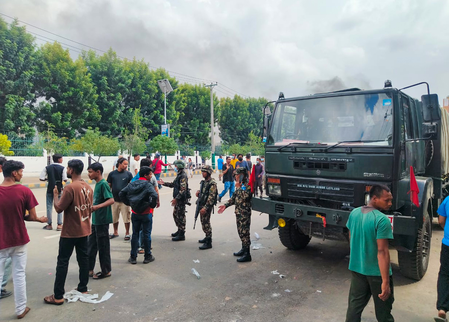
New Delhi, March 26 (IANS) A day before Nepal’s Rastriya Swatantra Party (RSP), which swept the March 5 national election, officially names its Prime Minister on Thursday, the interim government was reportedly forced to release a probe agency report that investigated the September 8-9 firing on youngsters in Kathmandu, that led to several deaths.
The commission, led by former Justice Gauri Bahadur Karki, submitted its report on March 8 to Prime Minister Sushila Karki.
Earlier reports suggested that the current government intended to hand over the document to the new Cabinet for it to decide the course of future action.
It was verified by IANS on ground in Kathmandu earlier this month, where officials claiming to be in the know had confirmed that despite intense pressure, the interim government was reluctant to make the report public.
Meanwhile, the RSP’s central committee is scheduled to meet on Thursday to elect its parliamentary party leader. It is expected to name the engineer-rapper and social media sensation, Balendra Shah, who RSP had earlier projected as its Prime Ministerial face.
All this while, activists linked to Nepal’s Gen-Z movement have been demanding the government make public the probe panel report.
“After the report’s unauthorised publication, the government on Wednesday evening decided to release not only the Karki commission’s findings but also the reports of High-Level Investigation Commission on the Nepal Child Organisation and Balmandir, 2020, along with the Good Governance Roadmap, 2025, prepared by the Office of the Prime Minister and the Council of Ministers,” reported The Kathmandu Post early on Thursday.
The protests of September 2025 were sparked by mounting frustrations among Nepal’s younger generation — popularly dubbed ‘Gen Z’ — over unemployment, corruption, and the government’s perceived indifference to their future.
Demonstrations began in Kathmandu, later spreading to other parts of Nepal.
Students, activists, and young professionals rallied under slogans demanding transparency, job creation, and electoral reforms.
However, what began as a civic movement quickly escalated into violent confrontations.
Security forces used tear gas, batons, and live ammunition in several instances, leading to several deaths and injuries.
In response to public outrage, the government established an independent enquiry commission in late 2025, chaired by former judge Gauri Bahadur Karki.
The commission was tasked with investigating the causes of the protests, the chain of command behind the crackdown, and recommending accountability measures.
Over six months, the committee interviewed hundreds of witnesses, reviewed security logs, and examined government communications.
The commission concluded that former Prime Minister K. P. Sharma Oli and then‑Home Minister Ramesh Lekhak bore direct responsibility for authorising the use of excessive force, reportedly recommending criminal prosecution against them.
According to leaked sections published by The Kathmandu Post, both leaders were found to have instructed security agencies to “neutralise” the protests, prioritising regime stability over citizens’ rights.
“The report of the judicial commission formed to investigate the September Gen Z protests states that the Nepali Army had prior information that the September 8 demonstration could see dangerous escalation,” it revealed on Thursday, after the report was made public.
The Nepal Police and Armed Police Force were criticised for disproportionate responses and lack of adherence to international norms on crowd control.
The report highlighted instances where live rounds were fired without provocation, contradicting official claims that protesters had turned violent first.
The Karki Committee report has apparently suggested institutional restructuring of security forces to ensure accountability.
Beyond immediate culpability, the report underscored the deeper socio‑economic roots of the protests. Chronic unemployment, rising cost of living, and lack of meaningful political representation for young people created fertile ground for unrest.
Outlets like Fiscal Nepal linked these frustrations to broader structural issues, including limited opportunities in Nepal’s IT and export sectors.
On such issues, the probe panel has urged reforms, with economic policies targeting job creation in emerging sectors. Media articles emphasised political ramifications, noting that the recommendation for criminal charges against a former Prime Minister is unprecedented in Nepal’s democratic history.
Civil society groups, however, argue that the report validates long‑standing concerns about impunity.
“For decades, leaders have escaped accountability for abuses. This report is a chance to break that cycle,” said one activist quoted in The Kathmandu Post.
Social media platforms have been flooded with commentary from young Nepalis, mixing celebration with cynicism.
“We fought, we bled, and now they admit it. But will they ever face justice?” read one widely shared post.
–IANS
jb/rad