
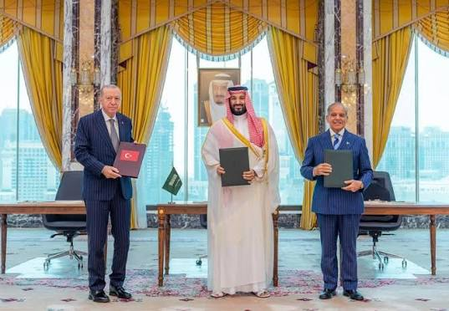
Islamabad, Aug 21 (IANS) Days after Pakistan signed the high-profile Mecca Joint Defence Agreement with Turkey and Saudi Arabia, three Pakistani sailors were among six people killed in a Houthi attack on the commercial vessel Tihamah in the Bab el-Mandeb Strait, underscoring the stark disconnect between high-level security agreements and the safety of ordinary Pakistani seafarers, a report has stated.
“On 7 August 2026, Turkey, Saudi Arabia and Pakistan signed a joint defence agreement. Ministers spoke of a new security architecture. Analysts wrote of strategic autonomy. Islamabad framed the deal as proof of its arrival as a regional security provider. Four days later, three Pakistani sailors died in the Bab el-Mandeb Strait,” a report in ‘Eurasia Review’ detailed.
“The ship was the Tihamah, Egyptian- and Yemeni-owned, Tanzania-flagged, carrying eleven crew and loaded with food. Houthi forces struck it with three ballistic missiles, killing four crew members outright — three Pakistani nationals and one Indonesian — and injuring seven others. Then, as rescuers closed in, they fired again, killing two rescuers. Six people died in all. Islamabad sent condolences. Little else followed,” it noted.
According to the report, thousands of Pakistani seafarers work aboard merchant vessels worldwide, sailing under the flags of Panama, Liberia, the Marshall Islands and Tanzania. Greek, Egyptian and Emirati shipowners employ them, and they send remittances back to their families in Pakistan each month.
Yet their names often do not appear on any Pakistani shipping manifest. The arrangement works as long as nothing goes wrong. But when a crisis strikes, the gaps in protection become stark: the flag state may have no naval capacity to protect them, while the ship owner’s obligations remain largely limited to insurance, the Eurasia Review report stated.
“And Pakistan, whose citizens they remain, has no standing claim over the vessel at all. So who moves when a missile hits? Nobody did. Yemen’s coastguard reached the Tihamah. Yemeni troops died doing it. No Pakistani asset participated, and no Pakistani mechanism existed to send one,” it mentioned.
Highlighting the gap in Pakistan’s maritime operations and its ability to protect its own citizens at sea, the report said the Pakistan Navy assumed command of Combined Task Force 150 in January 2026, relieving the Royal Saudi Navy. CTF-150 conducts maritime security patrols beyond the Arabian Gulf to counter non-state threats — covering an area of over two million square miles.
“Pakistan has also commanded the counter-piracy force CTF-151 eleven times. Islamabad publicises these appointments heavily. They signal competence. They buy standing in Bahrain and Washington alike. Yet the deaths occurred at precisely the chokepoint these formations exist to watch. Pakistan held a command. It did not hold a capability,” it highlighted.
The report argued that Pakistan has spent fifteen years building up multinational command positions, yet these roles have provided no corresponding protective benefit to Pakistani citizens. “The billet is the deliverable. Nothing else was ever on offer,” it stressed.
–IANS
scor/ksk/dan