
New Delhi, Nov 1 (IANS) About two decades ago, the then Pakistan President General Pervez Musharraf initiated ground-breaking reforms in the country’s higher education sector, with an objective to bring a complete turnaround in the functioning of colleges and universities and developing them as “centres of excellence”.
Decades later, the big-ticket reforms seem to have not just derailed from its purpose but rather staring at utter failure.
Despite unprecedented funding and ambitious reforms, Pakistan’s higher education experiment, which once grabbed international attention, is non-starter.
According to a Pakistani daily ‘The Dawn’, Pakistan has nearly 280 universities, millions of students and a rapidly expanding research output but they are struggling with mounting debts, poor educational outcomes and questionable scholarship, making their operations unviable and untenable.
The report says that billions were poured into setting up new universities, including signing of landmark agreement with US to launch what was then considered the world’s largest Fulbright scholarship programme but all that effort failed to live up to mark, decades later.
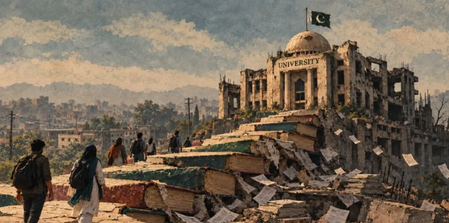
Highlighting the story of universities boom to bailout, the report says that the massive university expansion is collapsing under its own weight.
The issue played out in the national media, as almost all public universities in Khyber Pakhtunkhwa experienced severe financial distress and also demanded about Rs 25 billion package to bail out the entire sector.
“The bold reforms of 2002 that were to transform Pakistan into a knowledge economy have instead mutated into a gargantuan Frankenstein’s monster, which limps into its 25th year, too big to fail and too difficult to reform,” the report said, which is actually an investigative series studying the myriad issues plaguing the Pakistan’s education sector.
The report also added that it might be surprising to learn for many that the original architects of higher education enterprise foresaw this collapse.
“They even spelt it out explicitly for us in the original Task Force report of 2002, the founding document of our higher education experiment, which resulted in the Higher Education Commission Ordinance and the creation of the Higher Education Commission,” the report said.
–IANS
mr/khz