
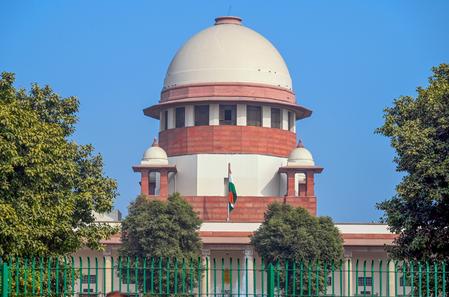
New Delhi, Feb 18 (IANS) The Supreme Court has set aside the controversial Allahabad High Court judgment that had ruled grabbing a minor’s breasts and breaking her pyjama string was not sufficient to constitute a charge of attempt to rape.
Disposing of the suo motu matter, including the criminal appeals arising from petitions filed by two NGOs and the victim’s mother, a Bench headed by Chief Justice of India (CJI) Surya Kant held that the Allahabad High Court’s reasoning was based on a “patently erroneous application of the settled principles of criminal jurisprudence”.
“The attempt made by the accused persons appears clearly and inevitably leads us to conclude that, prima facie, a case for invoking the provisions of attempt to commit rape has been made out by the complainant and the prosecution,” the Bench, also comprising Justices Joymalya Bagchi and N.V. Anjaria, said.
The suo motu proceedings were initiated following a letter addressed by senior advocate Shobha Gupta, Founder-President of ‘We the Women of India’, highlighting the “insensitive and legally flawed” observations in the Allahabad High Court’s order passed in March last year.
In its decision, a single-judge Bench of Justice Ram Manohar Narayan Mishra of the Allahabad HC altered the charges against the two accused, who were originally summoned by the trial court for commission of offences under Section 376 IPC (rape) and Section 18 (punishment for attempt to commit an offence) of the Protection of Children from Sexual Offences (POCSO) Act.
Partly allowing the revision plea of the accused persons, Justice Mishra held that they are instead liable to be summoned for a minor offence under Sections 354(b) IPC, i.e. assault or abuse of a woman with intent to disrobing or compelling her to be naked, read with Section 9/10 of the POCSO Act.
Disagreeing with that view, the Supreme Court referred to its earlier ruling in State of Madhya Pradesh v. Mahendra alias Golu and reiterated the distinction between “preparation” and “attempt” in criminal law.
“There is a visible distinction between ‘preparation’ and ‘attempt’ to commit an offence. (T)he stage of ‘preparation’ consists of deliberation, devising or arranging the means or measures, which would be necessary for the commission of the offence. Whereas, an ‘attempt’ to commit the offence starts immediately after the completion of preparation,” the CJI-led Bench observed, quoting from the earlier decision.
Examining the allegations, the Supreme Court observed that the accused had allegedly taken the minor victim on a motorcycle on the pretext of dropping her home, stopped near a culvert, dragged her, committed sexually offensive acts, and fled only when witnesses reached the spot on hearing her screams.
“A bare perusal of these allegations leaves no modicum of doubt that the case sought to be made out is that the accused persons proceeded with a pre-determined intent to commit an offence under Section 376 of the IPC on her,” the apex court said.
It added that “from the story of the complainant, the mens rea involved had begun to be executed” and that the only reason the crime was not carried further was the intervention of third-party witnesses.
Consequently, the apex court restored the original summons order dated June 23, 2023, passed by the Special Judge (POCSO), Kasganj, and confirmed its earlier interim direction that the trial shall proceed as if summons had been issued under Section 376 read with Section 511 IPC and Section 18 of the POCSO Act.
At the same time, the CJI Surya Kant-led Bench clarified that its observations were only from a prima facie perspective and “shall not be taken to be any opinion on the guilt of the accused persons, which is the subject matter of the ongoing trial”.
In its decision, the Supreme Court also addressed a “broader issue” flagged by the petitioners concerning judicial sensitivity in cases involving sexual offences and vulnerable victims. It requested the National Judicial Academy, Bhopal, through its Director and former SC judge, Justice Aniruddha Bose, to constitute a committee of experts to prepare a comprehensive report on developing guidelines to infuse sensitivity and compassion into judicial processes dealing with sexual offences and other vulnerable cases.
The expert panel, to be chaired by Justice Bose and comprising four other domain experts, has been asked to examine past measures, assess their on-ground impact, and prepare “Draft Guidelines for the Approach of Judges and the Judicial System When Dealing with Cases of Sexual Offences and other Similarly Sensitive Occurrences Involving Vulnerable Victims, Complainants, and/or Witnesses”.
“The primary beneficiaries of these guidelines are the victims/complainants, the majority of whom are children, women of tender age, and members of vulnerable sections of society,” the top court said, adding that the draft “will not be loaded with heavy, complicated expressions borne from foreign languages and jurisdictions”.
The committee has been requested to submit its report within three months.
The Supreme Court clarified that the report, once received, would be placed before the Chief Justice of India on the administrative side for appropriate instructions.
–IANS
pds/vd