
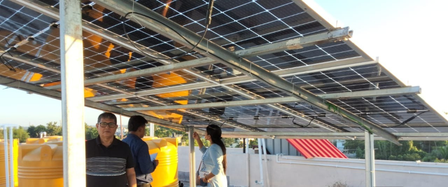
Agartala, Jan 24 (IANS) Tripura has achieved a significant milestone in the renewable energy sector by crossing 7 megawatt (MW) of solar electricity generation under the Pradhan Mantri Surya Ghar Muft Bijli Yojana (PMSGMBY), officials said here on Saturday.
Tripura State Electricity Corporation Limited (TSECL) Spokesman Bipul Bhowmik described the achievement as a historic moment in the state’s journey towards energy self-reliance and sustainable development.
According to the official, electricity generated from rooftop solar installations across the state has now exceeded 7 MW, reflecting growing public participation in renewable energy initiatives.
Beyond the numerical milestone, the development signals Tripura’s steady transition towards clean energy and reduced dependence on conventional power sources, the Spokesman said.
Bhowmik said the PMSGMBY scheme has opened unprecedented opportunities for electricity consumers.
By installing rooftop solar panels, households are not only able to reduce their electricity bills to zero but can also earn additional income by supplying surplus power back to the government grid.
Launched by Prime Minister Narendra Modi on February 13, 2024, the scheme aims to transform households into small power generation units.
Its twin objectives are to ease the financial burden of electricity bills and promote renewable energy for an environmentally sustainable future, the spokesman said.
Highlighting the encouraging public response in Tripura, the TSECL Spokesman said that 17,601 electricity consumers have already registered under the PM Surya Ghar scheme.
Of these, rooftop solar installations have been completed in 2,061 households, while 1,746 beneficiaries have received government subsidies.
Under the scheme, consumers are eligible for subsidies of up to Rs 85,800, making rooftop solar adoption financially viable, particularly for middle- and lower-income families.
Energy experts note that even a one kilowatt solar plant can generate an average of about 100 units of electricity per month, which is sufficient to meet an ordinary household’s monthly power requirement.
Any surplus electricity can be exported to the grid, providing consumers with additional income and long-term savings.
The TSECL has played a crucial role in implementing the scheme by offering technical support, conducting awareness programmes, and streamlining installation and grid connectivity processes.
The official said that the corporation has set an ambitious target of increasing Tripura’s solar power generation capacity to 50 MW within the next year.
“If achieved, this would bring a transformative change to the state’s power sector and significantly strengthen its renewable energy footprint,” the spokesman added.
With electricity costs steadily rising, power department officials said rooftop solar power is emerging as a practical pathway towards financial independence.
TSECL has urged consumers to take advantage of the scheme by registering through the official government portal or visiting the nearest corporation office.
Meanwhile, Tripura Power Minister Ratan Lal Nath recently said that if five lakh households install 2 kW rooftop solar panels, the state could generate nearly 1,000 MW of power daily, significantly enhancing power self-sufficiency.
He added that solar power systems are also being installed in 2,000 government buildings, a project expected to be completed next year and generate around 80 MW of electricity.
–IANS
sc/khz