
Washington, May 19 (IANS) Senior American lawmakers, diplomats and policy experts warned that the US-India relationship was at an “inflection point”, even as they reaffirmed bipartisan support for stronger defence, technology and economic cooperation between the world’s two largest democracies.
At the annual Capitol Hill Summit 2026 organised by the US-India Friendship Council, participants from bothside of the aisle highlighted concerns over trade tensions, visa restrictions and strategic uncertainty, while stressing that the long-term trajectory of the relationship remained strong.
Republican Senator Steve Daines, a member of the powerful Senate Foreign Relations Committee and Senate Finance Committee, described India as one of America’s most important geopolitical partners and stressed the importance of trust in the relationship.
“When trust was in the room, good things happened,” Daines said, quoting former Secretary of State George Shultz. “When trust was not in the room, good things did not happen.”
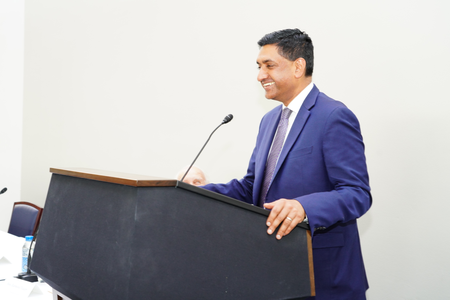
Indian American Congressman Ro Khanna said the partnership should be rooted in democratic ideals rather than narrow geopolitical calculations.
“We must, as the United States, build a multiracial democracy and work with India as a multiracial democracy,” Khanna said.
Congresswoman Deborah Ross argued that educational exchanges remained central to the future of bilateral ties.
“Indian students form the largest group of international students in the United States,” Ross said. “These bright students should be able to continue their education and research here.”
Former US Ambassador to India Richard Verma warned that recent tensions had exposed vulnerabilities in the relationship.
“The system is flashing a bit yellow,” Verma said, citing declining student visas, rising anti-Indian sentiment and tariff disputes.
At the same time, Verma emphasised that no other bilateral relationship had grown as rapidly as US-India ties over the past 25 years. Bilateral trade had risen from almost nothing to more than $200 billion, while defence cooperation had expanded dramatically, he noted.
During a later panel discussion, Congressman Ami Bera said temporary political disagreements should not obscure deeper strategic alignment.
“Nothing fundamentally has changed about our long-term strategic interest,” Bera said.
India’s Ambassador to the United States Vinay Mohan Kwatra said the relationship continued to enjoy bipartisan backing in Washington.
“We are natural partners not because of geography or compulsions of geography, but because of our shared values,” Kwatra said. He pointed to expanding cooperation in trade, semiconductors, defence, artificial intelligence and critical minerals.
Kwatra also credited the Indian American diaspora as a “foundational anchor” of the partnership and highlighted India’s economic transformation since 2014 as a major driver of closer ties with the United States.
Opening the summit, former US Assistant Secretary of Commerce Ray Vickery said the relationship had once appeared to have “its own momentum” after years of rapid growth, but now required renewed engagement.
“We’re gathered here today to try to refocus on the relationship between the two largest democracies in the world,” Vickery said. “There really is absolutely no issue facing the world today, whether it be economic, commercial, strategic, which can’t benefit from closer cooperation between the United States and India.”
US-India Friendship Council chairman Swadesh Chatterjee recalled the transformation in bilateral ties since the 1990s, when India faced American sanctions after its nuclear tests.
“Our most prominent success of the Indian American community is the US-India civil nuclear deal, which was signed in 2008,” Chatterjee said. “It ended India’s 34 years of nuclear isolation.”
–IANS
lkj/rs