
Washington, June 30 (IANS) India is “the only country on earth that fundamentally rivals China” in the depth of its engineering workforce and talent pool, a senior Trump administration official said, calling New Delhi a critical partner in building secure technology ecosystems and reducing global dependence on China.
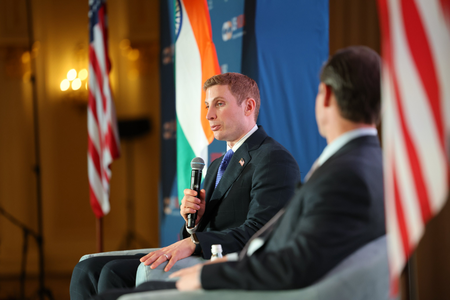
Jacob Helberg, the US Under Secretary of State for Economic Growth, Energy and the Environment, made the remarks during a fireside conversation with Tucker Foote, Chief Government Affairs and Policy Officer at Mastercard, at the ninth US-India Strategic Partnership Forum Leadership Summit in Washington.
“For us, India is an incredibly important partner,” Helberg said, noting that India was an early signatory to the PAX Declaration and a key participant in the administration’s technology and artificial intelligence diplomacy.
He said he had travelled to India in February for India’s AI Impact Summit, where the two sides marked India’s accession and published a joint statement on AI opportunity.
The statement, he said, later helped shape a broader declaration co-signed with 35 countries at a subsequent summit.
Helberg said India stood out because it combined democratic alignment, engineering talent, mineral refining capacity and a growing technology ecosystem.
“India is especially interesting because it is not only a country with who we have a deep values alignment, but India obviously is the only country on earth that fundamentally rivals China as with respect to the depth of its engineering workforce and talent pool,” he said.
He also pointed to India’s “very deep mineral refining industry” and its “true nascent technology ecosystem”, saying the country was making important contributions at the application layer of technology.
That application layer, he said, would be essential for wider diffusion of new technologies.
Helberg said the United States did not view technological progress as a zero-sum contest among partners.
“We don’t view it as a zero sum game,” he said, adding that Washington was not threatened by the success of other companies in the technology space because the technology industry was “a pie that grows”.
He said India’s scale and talent made it a natural partner in building what he called a shared developer ecosystem.
“The reason that India is such an important partner in this endeavor is because, it has so many engineers, because of the size, the needs of its population are, are so substantial by virtue of a demographic size as well as its rapid economic growth,” Helberg said.
Helberg said the current global supply chain structure could not continue because it was too geographically concentrated and vulnerable to disruption.
“The supply chains are, as they stand today, are too overly concentrated geographically and thematically in some places. And they need to be diversified,” he said.
He said the objective was to reduce overdependence on China and build greater production capacity elsewhere.
“Broadly speaking, we want to increase production capacity outside of China in order to de-risk our overall over concentration with China,” Helberg said.
He cited India’s role in memory capacity, mineral refining and AI applications as areas where the two countries could deepen collaboration.
At the physical supply chain level, he said India and the United States had opportunities to work together on key inputs. At the software level, he said India could become a “transformative partner” in developing a dynamic AI developer ecosystem.
“We think India can be a transformative partner to develop a very, very dynamic AI developer ecosystem,” Helberg said.
He said American platforms could serve as developer tools for Indian entrepreneurs and startups building applications for the Indian market.
“We think it will actually benefit everyone by encouraging entrepreneurship in India and allowing the use of American platforms as developer tools to develop new Indian companies and startups for the Indian market,” he said.
Helberg also warned against what he described as the “digital sovereignty” or “AI sovereignty” trap.
He said many countries were debating whether sovereignty required full local control of the technology stack, but argued that rebuilding everything domestically would be economically damaging.
“The danger is that that concept is being weaponized by a number of different voices overseas to be interpreted in a way that it really means we’re gonna rebuild in-house the entire stack top to bottom in order to be sovereign,” he said.
“We think that is incredibly backward and really, really dangerous economically for them because what that means is they’re going to sink billions of dollars in resources to reinvent something that already exists,” he said.
Helberg said such an approach would likely produce “massively suboptimal results” and divert engineering talent and capital away from future innovation.
“Sovereignty comes from being a net contributor to the world’s innovation ecosystem,” he said.
He argued for an ecosystem-based approach in which trusted partners build together and use each other’s strengths.
“Our companies use SK Hynix memory chips, we’re fine using SK Hynix memory chips. We use lots of different suppliers from lots of different places,” he said.
Helberg said the State Department was pursuing what he called a “product centric approach to foreign policy”, moving away from process-heavy models that produced working groups but few tangible outcomes.
“I think in the past a lot of efforts related to foreign policy have been very, very focused on process,” he said.
“We want to focus on a product,” he said.
He cited an AI platform for the Panama Canal, an economic security zone framework in the Philippines, and a partnership with Stanford on advanced manufacturing curriculum as examples of initiatives designed to be replicated and scaled.
Helberg said the private sector had an integral role in this approach.
“We believe in a pro innovation, pro growth policy agenda. We believe in mobilizing the private sector and driving free enterprise,” he said.
Foote said Mastercard viewed India as a major technology base, noting that India was the company’s second largest workforce outside the United States and home to its largest global technology hub in Pune.
He said one of the recurring questions in the US-India relationship was how both countries could build technology together “in a protected, secure way.”
Helberg said the goal was to create secure and predictable supply chains for companies in the United States, India and other partner countries.
“We want a future where we have supply chain reliability and predictability for our companies,” he said.
“We don’t want any of our companies to have to ask anyone for permission in order to get access to the inputs they need to make things in America. We’re in India. We want all of our companies to have that level of economic security,” he said.
He said the second goal was abundance.
“We want a future with abundance where you can actually scale production quickly and easily in order to have abundant memory chips, abundant logic, chips, abundant minerals, abundant, all the inputs that we need that are currently massively supply constrained,” Helberg said.
He said some Chinese companies were trying to exploit supply constraints by filling gaps in global demand with their products.
“We think we will compete by through a strategy of abundance and supply chain reliability,” he said.
The remarks came as India and the United States continue to expand cooperation in artificial intelligence, critical minerals, semiconductors, advanced manufacturing and secure supply chains.
The USISPF summit brought together senior officials, diplomats and business leaders from both countries to discuss the next phase of the bilateral partnership.
–IANS
lkj/rs