
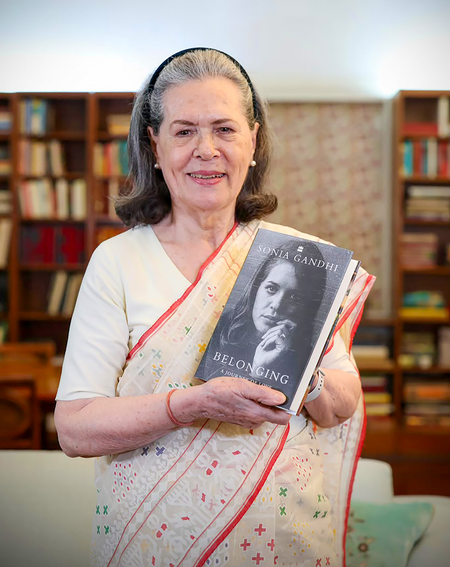
New Delhi, Nov 15 (IANS) There is something quite intriguing about political memoirs, especially when they concern one of the most powerful political families in the country. The Gandhi family and its leaders have, over the decades, guarded their political secrets, maintained a carefully cultivated public image and kept internal differences, whether within the family or the party, behind closed doors.
But suddenly, one of the most powerful members of the family has decided to be candid and put her life story on paper.
Sonia Gandhi’s recently published memoir, ‘Belonging: A Journey of Love’, has brought out several uncomfortable questions about the family, the Congress party, its leadership and the way power was actually exercised during the UPA years, etc.
Equally interesting is the timing of its release, coming at a time when the family has been trying to build narratives, both political and personal, around Rahul Gandhi.
The irony is that a party which has repeatedly accused its political opponents of distorting history is now finding itself answering questions arising from the recollections of its own first family.
Whether the memoir is also an attempt to invigorate the party’s somewhat sullen cadres or build an aura around Rahul Gandhi, who has lately adopted an increasingly aggressive political posture on several issues, is open to interpretation. Whatever the intention, the book has raked up considerable controversy.
What makes the revelations particularly interesting is that they concern people who were not ordinary political functionaries but some of the most powerful names in the Congress establishment.
Take the case of former President Pranab Mukherjee. Sonia Gandhi has recalled a conversation with him in 2010. “On one occasion, in 2010, I think after expressing his frustration, he shocked me with the suggestion that perhaps it was time for a change at the top, which I understood as a hint of his long-held desire to become Prime Minister,” Sonia Gandhi writes in her book.
She understood this as his long-held desire to become Prime Minister, and the suggestion apparently came as a shock to her. Now, there is nothing unusual about a senior political leader aspiring to become Prime Minister. In fact, it would be rather surprising if someone with Pranab Mukherjee’s experience, political standing and years in government did not harbour such an ambition.
However, it was the reaction of his daughter, Sharmistha Mukherjee, that made the episode even more interesting. Her response reflected a certain uneasiness within the Gandhi family when it came to senior leaders asserting their own political ambitions.
Questioning why Sonia Gandhi was shocked by her father’s ambition, Sharmistha pointed out that Pranab had earned his position through decades of hard work and merit, without anybody serving him political positions on a platter because of dynastic entitlements. She even raised the uncomfortable question of whether Sonia was surprised that somebody outside the Gandhi-Nehru family could aspire to become the Prime Minister.
That was quite a pointed observation. And it has brought back a question that the Congress party has never been particularly comfortable answering. Does the party genuinely provide an equal opportunity to its senior leaders to rise to the top, or does the Gandhi family continue to remain the final authority on who gets what position and how far somebody can go?
The memoir also revisits another controversy that has followed Sonia Gandhi for years — whether she was the real power behind the Manmohan Singh government. Sonia has maintained that there was a clear division of responsibilities, with former PM Manmohan Singh running the government and her taking care of the party. She has rejected allegations that she interfered in official files, administrative matters, or appointments.
However, the political reality of the UPA years was that Sonia Gandhi was not just another Congress President. She was the chairperson of the UPA and the most powerful political figure in the ruling establishment. The National Advisory Council, the coordination mechanism between the party and the government, and the regular meetings of senior leaders were all part of a political arrangement in which her influence was undeniable.
There is a difference between exercising political influence and interfering in government functioning. But the perception that the Prime Minister’s authority was often overshadowed by the Congress leadership did not emerge out of thin air. It became one of the most persistent political criticisms of the UPA government. Sonia’s explanation may put forward her side of the story, but it is unlikely to put the controversy to rest. In fact, the book somehow deepens the thought.
The memoir has also reopened the debate over some of the most difficult chapters in Congress’ history, including the Emergency imposed by Indira Gandhi in 1975 and the anti-Sikh riots of 1984. Sonia describes the riots as a tragic episode and speaks of the failure to deliver timely justice. Her account has drawn criticism, particularly over the manner in which the responsibility and role of the Congress leadership are presented. She has also sought to defend her husband, Rajiv Gandhi, who succeeded his mother Indira Gandhi as the Prime Minister after her assassination in 1984, against allegations of complicity in the events that followed.
Even more interesting is her account of the Emergency and the manner in which she appears to place much of the blame for its excesses on Sanjay Gandhi, her brother-in-law. It is also interesting how she approaches the bitter family relations involving her sister-in-law, Maneka Gandhi. The differences between the two branches of the family, which eventually became public, add another dimension to the account of a family that was not only at the centre of Indian politics but also had its share of internal conflicts.
Political memoirs are, after all, personal accounts. Nobody should expect a leader to write a chargesheet against herself or her own family. But when the subject is a political party that has governed India for decades, its history cannot be treated as a purely family matter.
The events, decisions and personalities involved have shaped the country’s political course and therefore deserve public scrutiny.
Many questions remain unaddressed in the memoir. What about the Quattrocchi-Bofors controversy, the various scams that dogged the UPA years, the questions surrounding her voter ID, or the allegations of minority appeasement in the Babri Masjid and Batla House episodes, or the 2002 Gujarat riots? While she said the riots deeply affected her, Sonia failed to mention the plight of the Kashmiri Pandits who were forced to flee the Valley in the early 1990s. She talked about Kashmiri traditions and delicacies, but omitted the displacement and suffering of Kashmiri Hindus. These are issues that have been part of the country’s political debate for years, and readers may well have expected some answers.
And this is precisely where Congress finds itself in an uncomfortable position. For years, the party has spoken about its democratic traditions, institutional values and glorious political legacy. Questions about internal democracy, leadership succession and the extraordinary influence of one family have continued to follow it.
The family, too, has guarded its secrets rather well over the decades. But Sonia’s memoir now provides an account that, inevitably, represents only one side of the story. There will be others who may have a very different recollection of the same events.
Congress may have guarded its family secrets for years, but political memoirs have a way of bringing old conversations back into public life. And Sonia Gandhi’s book has sought to layer more secrets, as it provides a guided perspective and glimpse.
(Deepika Bhan can be contacted at deepika.b@ians.in)
–IANS
dpb/khz