
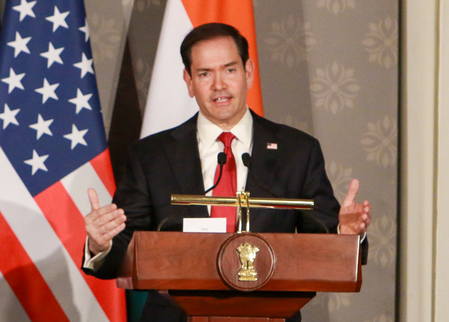
Washington, June 4 (IANS) From trade negotiations and Quad cooperation to maritime security, critical minerals, and regional diplomacy, India emerged as one of the most frequently discussed countries during Secretary of State Marco Rubio’s testimony before Congress on Wednesday, underscoring New Delhi’s growing importance in the Trump administration’s Indo-Pacific strategy.
Appearing before the House Foreign Affairs Committee to defend the State Department’s Fiscal Year 2027 budget request, Rubio repeatedly cited India while outlining what he described as the administration’s diplomatic achievements and strategic priorities. Members of Congress from both parties also raised India-related issues during the hearing, reflecting the country’s expanding role in US foreign policy discussions.
The most significant development for India came when Rubio disclosed that Washington and New Delhi are nearing completion of a bilateral trade agreement.
Responding to questions from Rep. Bill Huizenga about his recent India visit, Rubio said the two sides were close to finalising a deal.
“The hopes that we can wrap up the negotiations on our trade agreement, which we think were a few weeks away from being able to conclude,” Rubio said, adding that “both sides want to see it done.”
Rubio said the India trip also included discussions with the foreign ministers of the Quad, the grouping that includes India, the United States, Japan, and Australia.
“The quad, an important alliance in the Indo-Pacific between India, Japan, Australia, we’ve had multiple meetings of that group, including a meeting just last week in India and a follow-up that’s going to occur later this year, including a leaders meeting before the end of the year,” Rubio told lawmakers.
Later in the hearing, Rep. Ami Bera sought an update on Quad cooperation and the prospects for a leaders’ summit. Rubio said the administration hopes to organise a Quad leaders’ meeting later this year, potentially on the sidelines of another international gathering.
The secretary also revealed that the four countries are moving beyond dialogue towards practical cooperation in maritime security.
“One of the things we’ve agreed to work on is domain awareness, working together and pooling our resources so that we can have domain awareness about what’s happening out in the sea,” Rubio said. He noted that such cooperation would help monitor shipping lanes, undersea cables, sanctions evasion, and other activities across the Indo-Pacific.
India also featured prominently in Rubio’s discussion of efforts to reduce dependence on China in strategic sectors.
He highlighted a rare-earth ministerial attended by more than 30 countries aimed at securing critical mineral supply chains.
“We held a rare Earths ministerial that was attended by over 30 countries from around the world, all of which were signing up for an American-led effort to ensure that critical supplies of rare earth minerals around the world are available for our emerging economies, and we don’t remain overly dependent on China,” Rubio said.
Rubio also pointed to “Pax Silica”, a 14-country initiative designed to protect supply chains critical to artificial intelligence development, an area where India is increasingly seeking a larger global role.
Perhaps Rubio’s most striking India-related remark came during his opening statement, when he claimed Washington had helped prevent a wider conflict between India and Pakistan.
“India and Pakistan were on the verge of an all-out war. The State Department and I personally were involved in de-escalating that conflict and bringing it to an end, a war between two nuclear powers,” he said.
The hearing offered a rare glimpse into how India increasingly cuts across multiple pillars of US foreign policy.
The United States and India have steadily expanded cooperation over the past decade through defence agreements, technology partnerships, semiconductor initiatives, and the Quad framework. As Washington seeks to strengthen its position in the Indo-Pacific, India has become an increasingly important strategic partner in areas ranging from economic resilience and critical minerals to emerging technologies and regional security.
–IANS
lkj/dan