
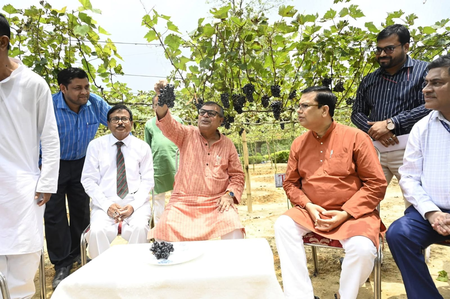
Agartala, June 3 (IANS) Agriculture and Farmers’ Welfare Minister Ratan Lal Nath on Wednesday said that the Tripura government would take a series of initiatives to promote grape cultivation in the state, including conducting trials on 18 additional grape varieties.
The Minister, while addressing a field day-cum-awareness programme on commercial grape cultivation and the launch of NABARD-funded projects at Chandipur in Unakoti district, said the state government will intensify research activities, develop suitable cultivation technologies, and provide comprehensive training and support to farmers.
As part of the programme, Nath visited an orchard where sweet grapes have been successfully cultivated for the first time in the Northeastern state. He also distributed power-operated agricultural equipment among farmers to support modern farming practices.
Later, speaking to the media, the Minister said the average grape productivity in India is around 24 metric tonnes per hectare and expressed confidence that Tripura could emerge as a promising grape-growing region through scientific interventions and farmer support.
He said scientists in Tripura have been carrying out extensive research on grape cultivation over the past few years. Following a series of research studies, scientists have successfully cultivated four grape varieties, including two wine grape varieties.
Nath added that the government will explore all possible ways to support grape growers and will provide proper training to farmers to ensure scientific and sustainable cultivation practices.
He said that after a nearly two-decade gap, the Krishi Vigyan Kendra (KVK) Unakoti resumed research and development on grape cultivation in 2024. Preliminary results indicate encouraging performance in terms of sweetness, yield, and overall fruit quality.
The Minister informed that six grape varieties were brought to Tripura from the ICAR–National Research Centre for Grapes in September 2024 and subsequently planted under experimental conditions.
He said the team of scientists is working diligently to standardise grape cultivation techniques suitable for non-traditional grape-growing regions like Tripura. Their efforts are aimed at identifying varieties and practices that can perform well under the state’s unique agro-climatic conditions.
Nath noted that several challenges continue to hinder large-scale grape cultivation in the state. These include insufficient fruit sweetness, limited suitability of introduced varieties, excessive rainfall, high humidity, non-availability of certain agrochemicals required for grape cultivation, and inadequate awareness and technical knowledge among farmers.
To address these challenges, scientists have already adopted special treatments and management practices to improve grape quality and sweetness. Specific interventions such as improved nutrient management and the use of growth regulators have been introduced to enhance the sweetness and overall quality of grapes. These efforts are yielding encouraging results.
Outlining the future roadmap for grape cultivation in Tripura, Nath said the government would formulate recommendations based on ongoing research findings and submit them for policy support. Trials will be conducted on 18 more grape varieties to identify the most suitable cultivars for the state’s climatic conditions.
The future action plan also includes intensified research and technology development, corrective measures based on field observations, organisation of extensive farmer training programmes on grape cultivation, development of grape cultivation clusters, and establishment of vineyards across suitable locations in the state.
In addition, the government plans to provide farmers with all necessary agricultural inputs and technical support, organise training programmes on grape juice and Ready-to-Serve (RTS) beverage preparation, impart training on post-harvest management of grapes, and establish cluster-based small-scale grape juice processing units to enhance value addition and generate additional income opportunities for growers.
Sports and Youth Affairs Minister Tinku Roy, senior officials of the Directorate of Horticulture, scientists, agricultural experts, and local farmers were also present at the programme.
–IANS
sc/dan