
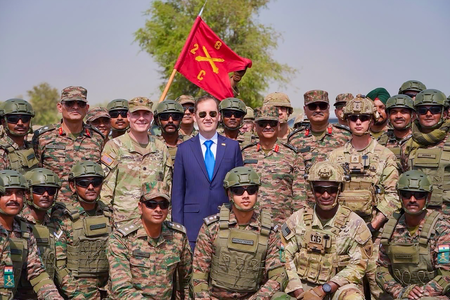
“The defence-to-defence ties are really strong and growing, but the executive-to-executive ties are at a bit of a low point,” Hultquist said, according to the details of the meeting released by the US Army.
“The military instrument for competition is really important, and it’s really the only one that’s working well. But you can’t replace all of the instruments of national power,” he added.
The assessment came during a wider discussion on how the United States can build and sustain alliances and partnerships as strategic competition intensifies across the Indo-Pacific.
Hultquist described India as the focal point of influence in South Asia and said Washington has adopted a hub-and-spoke approach aimed at developing India as a long-term, values-based partner.
India sits at the hub of that approach, reflecting its desire to remain a central regional power, according to the discussion.
“The US has dealt with this by deciding to trade access to the smaller states in the region for a chance at an India partnership,” Hultquist said.
The strategy, according to the presentation, places India at the centre of regional influence and gives Washington a “strategic counterweight” to China.
But China has expanded its economic influence among smaller South Asian countries through its Belt and Road Initiative, complicating US efforts to build partnerships in the region.
The panel said the US-India relationship has nevertheless begun to thaw over recent decades, reflected in an increase in military exercises and collaboration between the two countries’ defence industrial bases.
The discussion also examined the changing role of BRICS and its potential impact on the strategic and economic balance in the Indo-Pacific.
Dr Mahir Ibrahimov, director of the Cultural and Area Studies Office, said the grouping’s expansion had increased its economic weight.
BRICS “represents a collective GDP of more than $31 trillion, accounting for approximately 27 per cent of global GDP, according to recent estimates. This substantial share makes BRICS one of the most influential economic groups in the world,” Ibrahimov said.
“Although some experts note that this organisation might not be unified and efficient in achieving its stated results, however, it’s very important to note that BRICS is increasingly attempting to position itself as a counterweight to US-led financial dominance, and the petrodollar sits at the centre of that shift,” he said.
The panel also examined Japan and the Association of Southeast Asian Nations as Washington and Beijing compete for influence.
Lt. Col. Jason LeVay, an instructor at the Command and General Staff College, said Southeast Asian governments place particular importance on maintaining their freedom of choice rather than being forced into competing camps.
“The important point from a Southeast Asian perspective is that either relationship becomes problematic when it begins to reduce sovereign choice,” LeVay said.
“The United States does not necessarily need Southeast Asian states to choose America. It needs to remain a partner they repeatedly choose,” he added.
India and the United States have significantly expanded defence cooperation over the past two decades, including through more frequent military exercises, defence technology initiatives and agreements intended to improve military interoperability.
India is also a member of the Quad alongside the United States, Japan and Australia. New Delhi has simultaneously maintained its emphasis on strategic autonomy and its participation in BRICS, reflecting its approach of pursuing relationships with multiple major powers rather than entering a formal US-led alliance.
–IANS
lkj/sd/